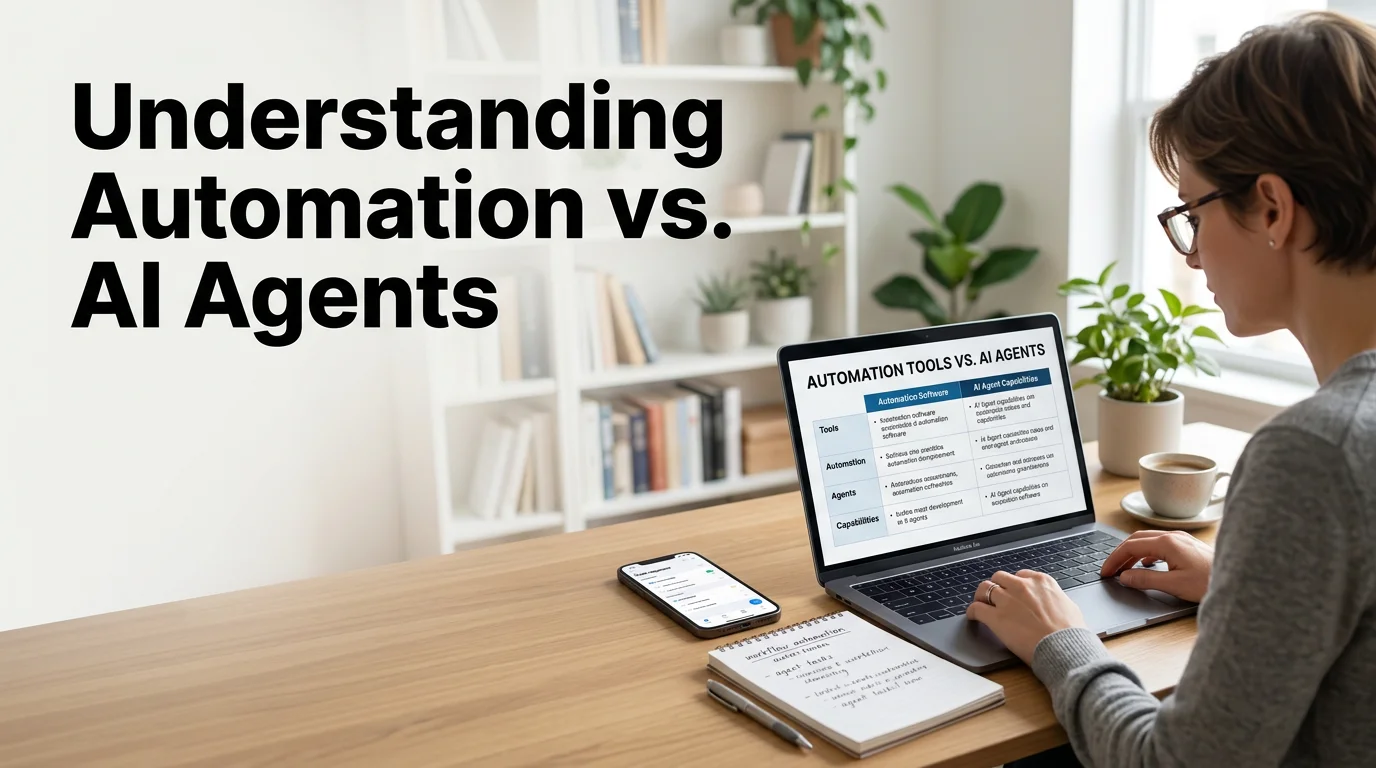
Stop Conflating These Two Things: It’s Costing You the Right Tool Every Time
The vocabulary around AI-powered operations has expanded faster than the conceptual clarity needed to use it well. Terms that describe different capabilities get used as if they were interchangeable, which leads to mismatched tool choices and disappointed expectations.
Automation and AI agents are not the same thing. They solve different kinds of problems, operate on different principles, and carry different trade-offs. A business that understands the distinction can make better decisions about where to invest, what to build, and what to expect from each. A business that conflates them tends to either over-engineer simple problems or under-resource complex ones.
What Automation Is
Automation, in the traditional sense, is rule-based. It follows a defined set of instructions that specify: when this specific trigger occurs, execute these specific actions in this specific sequence.
The trigger might be a form submission, an email arriving with a particular subject line, a date and time, or a status change in a project management tool. The actions that follow are predetermined. Send this notification. Create this record. Move this file. Generate this document. Update this spreadsheet.
The defining characteristic of automation is that it is deterministic. Given the same inputs, it produces the same outputs every time. It does not make judgment calls. It does not handle ambiguity. It does not improvise when something unexpected occurs. It executes the rules it was given.
This is a feature, not a limitation. Determinism is what makes automation reliable. When you know exactly what a process should do, automation handles it with perfect consistency, at any volume, without fatigue or error. That consistency is the core value proposition.
Where automation breaks down is at the boundary of its rules. Inputs it was not designed for, situations that require contextual reading, decisions that depend on information that does not exist in a structured form, these are the places where rule-based automation either fails silently, produces wrong outputs, or requires a human to intervene.
What an AI Agent Is
An AI agent is goal-directed. It works toward a defined objective and decides along the way how to reach it, with no fixed sequence of instructions to follow.
An agent is typically equipped with a set of tools it can use: the ability to search the web, read and write files, query databases, send messages, browse websites, generate text, or call external APIs. When given a goal, the agent determines which tools to use, in what sequence, based on what it encounters as it works.
The key capability that distinguishes an agent from an automation is the ability to handle variability. An agent can read a situation, interpret what it means, and adjust its approach accordingly. If it retrieves information that changes what the next step should be, it changes the next step. If it encounters an unexpected result, it can reason about how to proceed.
This makes agents useful for work that involves judgment, research, multi-step reasoning, or variable inputs that cannot be fully anticipated in advance. A research task that requires synthesizing information from multiple sources. A customer inquiry that requires reading context before determining how to respond. A data analysis task where the right questions to ask depend on what the initial data reveals.
The trade-off is that agents are less predictable than automations. They are operating with more autonomy, which means there are more ways for the outcome to diverge from what was intended. They also tend to be more expensive per run because they use more computational resources and involve more decision steps.
The Practical Difference in Operation
A concrete comparison helps clarify the distinction.
Consider a process for handling incoming client requests. A traditional automation might work as follows: when a form is submitted, create a record in the project management tool, send a confirmation email to the client, and notify the account manager via Slack. The same three steps happen every time, regardless of what the form contains.
An AI agent handling the same process might do something different: read the content of the request, assess its urgency and complexity, determine which team member is best suited to handle it based on workload and expertise, draft a personalized acknowledgment that references the specific request, create a record with an automatically generated brief summarizing the key requirements, and flag it as high-priority if the content suggests a time-sensitive need. Each of those steps involves judgment that a rule-based automation could not perform.
The agent’s output is richer and more context-aware. It also involves more steps, more potential failure points, and more variability in how it handles edge cases.
When to Use Automations
Automations are the right tool when the process is well-defined, high-frequency, and consistent. The trigger is clear. The action sequence is fixed. The expected output is the same type of result every time.
Scheduling confirmations, invoice generation, data entry, file organization, status notifications, and standard follow-up sequences are all automation territory. These processes benefit enormously from the reliability and consistency that automation provides. An agent would be over-engineering the solution and introducing unnecessary unpredictability.
Automations are also the right foundation layer for most operational systems. They handle the volume, the routing, and the predictable sequences that keep the business running. Everything on top of that foundation can then incorporate agents where judgment is actually needed.
When to Use AI Agents
Agents are the right tool when the task requires judgment, research, or contextual decision-making that cannot be encoded in fixed rules.
Research and synthesis tasks are a natural fit. When a process requires gathering information from multiple sources, interpreting what it means, and producing a structured output based on that interpretation, an agent can perform that work far more effectively than a human doing it manually or an automation trying to approximate it with rigid rules.
Triage and routing tasks with genuine complexity benefit from agents. When an incoming request, support ticket, or inquiry could plausibly be handled several different ways and the right path depends on content that is not fully structured, an agent can read the situation and make a more informed routing decision than a rule-based system can.
Draft generation with contextual awareness is another strong use case. When the right response to a situation depends on the specifics of that situation, an agent that reads the context and generates an appropriate draft produces better output than a template that fills in fixed variables.
The Hybrid Architecture
In practice, the most effective operational systems combine both. Automations handle the predictable, high-volume backbone. Agents handle the parts that require judgment. The two work together.
A lead management system might use automation to capture and route every incoming lead to the right team member with a basic notification. For leads above a certain value threshold, an agent is triggered to research the company, prepare a briefing, and draft a personalized outreach message. The automation handles volume and consistency. The agent adds intelligence where it creates the most value.
This architecture also helps manage cost. Agents are more expensive per operation than automations. Running an agent for every instance of a high-frequency, low-complexity process is wasteful. Reserving agents for the instances where their judgment capability actually matters keeps the cost proportionate to the value being created.
Risk Considerations
Both tools carry failure modes, but they are different in character.
Automation failures are usually easy to detect: the process either ran or it did not, and the output is either correct or it is not according to the defined rules. When an automation fails, the failure tends to be consistent and reproducible, which makes it easy to diagnose and fix.
Agent failures are more varied. An agent might complete a task but reach a wrong conclusion because of how it interpreted ambiguous information. It might take an unexpected path through a multi-step process that produces a technically valid but unintended result. It might perform differently on different runs of the same task because the information it encountered varied slightly.
Monitoring agents requires attention to output quality as well as to whether the run completed. Building in human review checkpoints for high-stakes agent outputs is a reasonable safeguard until the agent’s behavior on a given task is well-understood and trusted.
Are AI Agents the Same as Automations?
No. An AI agent is a different kind of tool, though in practice the two get combined. Take the client request example above. The automation follows 3 fixed steps on every form. The agent reads what the client wrote and decides what to do with it. If you swap the agent for a fixed rule, the judgment steps disappear.
The question to ask of any tool sold as an agent is whether it picks its own next step based on what it finds. If every step is fixed in advance, it is an automation with an AI label.
What Is AI Agent Automation?
AI agent automation means an agent runs inside an automated workflow. A trigger starts the process, the agent handles the step that needs judgment, and the automation carries the result onward. The lead example in the hybrid section works this way. The automation captures and routes the lead, and the agent does the research and drafting for high-value ones.
Most small firms get the best results by automating the predictable parts first and adding an agent to one judgment step at a time.
Free AI Agents and Automations: What to Expect
Many automation and agent platforms offer free tiers, and they are a reasonable way to test a process before you commit. Check the run limits and what happens when you hit them, because agents consume more per run than a simple automation. Once the process matters to the business, assign an owner and budget for monitoring, since a free tool with no one watching it is where quiet failures start.
Matching the Tool to the Task
The practical rule is simple. If the work is predictable, consistent, and rule-expressible, build an automation. If the work requires judgment, handles variable inputs, or involves multi-step reasoning toward a goal, consider an agent. If the work has both predictable elements and judgment elements, build a hybrid that uses automation where rules suffice and deploys agent capabilities where they are actually needed.
Understanding the distinction prevents both over-engineering and under-investment. Simple processes deserve simple solutions. Complex processes deserve tools that can actually handle their complexity. Getting that match right is a significant part of what makes an automation architecture effective over time.
Related reading: Automation Architecture for Small Teams · When Not to Automate: The Processes That Should Stay Human · 7 AI Agent Use Cases That Survive a Real 30-Person Firm
Building an automation architecture that uses the right tool for each job? Start with the free process audit.