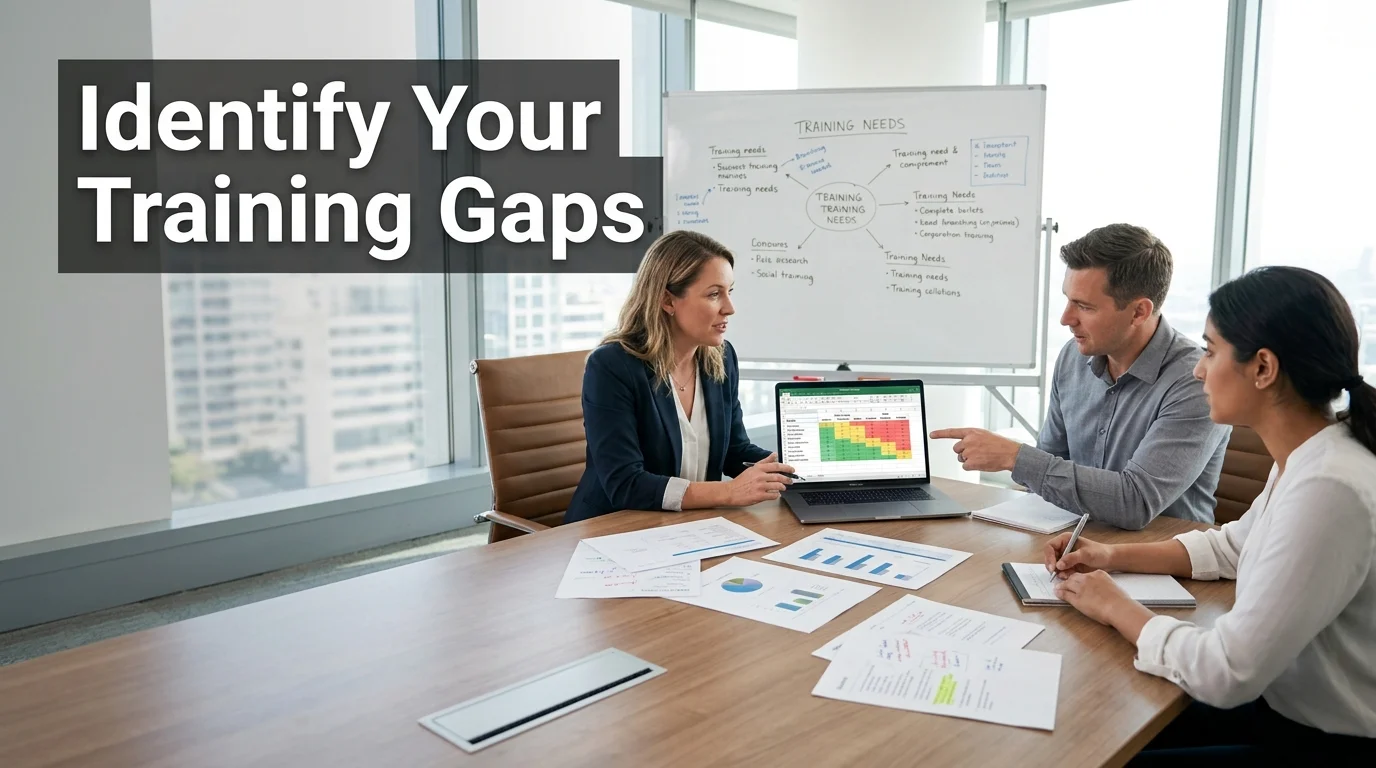
An AI training gap analysis shows where each person on your team stands against where their role needs them to be. Run it before you design any training.
The short answer
- An AI training gap analysis measures the distance between each person’s current AI skills and the proficiency their role requires, and produces a prioritized list of training needs.
- Define the target state for each role first. Without it you can only describe current behavior, not a gap.
- Assess current skills with a survey, a practical skills check using two or three real tasks, and direct observation. Self-assessment alone is unreliable.
- Gaps fall into four types: knowledge, skill, motivation, and process. Each one closes a different way, and process gaps close with redesign rather than training.
- Prioritize gaps by how often the task happens and how much time or quality is lost without AI, then run a lighter analysis every six months.
Find out where each person actually stands before you design a single training session
Most small businesses approach AI training the same way they approach most problems: they identify a solution before they fully understand the problem. A team member attends a conference and returns with enthusiasm for a specific platform. A founder reads that AI can save twenty hours a week and signs up for a tool that afternoon. Training gets built around whatever was just purchased rather than what the team actually needs.
The result is predictable. The training covers the wrong skills for the wrong roles. People learn things they will never use. The gaps that are actually limiting performance stay in place.
A training gap analysis fixes this by starting with the question that should come first: where is each person on the team relative to where they need to be?
What a Training Gap Analysis Is
A training gap analysis is a structured assessment of the distance between current AI skills across your team and the AI proficiency required to do their jobs effectively. It does not assume what the gaps are. It discovers them.
The analysis has three outputs. First, a map of current AI literacy by role and individual. Second, a definition of the target proficiency level for each role. Third, a prioritized list of training needs ordered by business impact.
This is different from asking “does everyone know how to use ChatGPT?” That question tells you almost nothing useful. A gap analysis tells you that your operations manager can draft communications effectively with AI but has no process for using AI in data review, that your client services team is using three different tools inconsistently without shared prompting standards, and that your new hire has strong technical AI literacy but does not know how to apply it within your specific workflows.
That level of specificity is what makes training effective.
Step 1: Define the Target State for Each Role
The gap analysis starts with the finish line, not the starting line. Before assessing anyone’s current skills, define what AI proficiency looks like for each role in your business.
This does not require predicting every possible AI use case. It requires identifying the AI applications with the biggest payoff for each function and defining the specific skills needed to execute them.
For a client services role, the target state might include: drafting initial client responses using AI with fewer than two rounds of editing, using AI to summarize client communications before meetings, and maintaining a personal prompt library for the five most common response types.
For an operations role, the target state might include: using AI for data analysis and report drafting, building and maintaining AI-enhanced SOPs for core processes, and conducting quality review on AI-generated outputs before distribution.
Write these down. They become the benchmark against which you assess current skills and the definition of success for your training program.
Step 2: Assess Current Skills
Once you have a target state defined for each role, assess where each team member currently stands. This is done through a combination of a structured survey, a practical skills check, and direct observation.
The survey covers usage patterns and self-assessment. Ask how frequently team members currently use AI tools, which tools they use, what types of tasks they apply AI to, and how confident they feel about their outputs. Include open-ended questions about what they find frustrating and what would make AI more useful for their specific work.
Self-assessment is imperfect. People tend to overestimate their proficiency in areas where they have had positive experiences and underestimate in areas where they feel uncertain. Use the survey as a starting point, not a final answer.
The practical skills check asks each team member to complete two or three tasks from their actual job using AI. Review the outputs and the process. This reveals the gap between perceived skill and actual skill far more accurately than any survey. You will often find that someone who rates their AI confidence as high produces outputs that require extensive editing, and someone who rates themselves as low actually has a strong prompting instinct that just needs direction.
Direct observation is the most time-consuming option but produces the richest information. Sitting with one team member for thirty minutes while they work through a real task with AI reveals the friction points, the workarounds, and the habits that neither surveys nor task reviews can capture.
Step 3: Map the Gaps
With both a target state and a current state defined, the gaps become visible. Document them by role and by individual.
Gaps fall into four categories, and understanding which type you are dealing with determines how you address them.
Knowledge gaps are the most common. The person does not know what AI can do for their specific role, or does not know how to use the tools available to them. These close with direct training and examples.
Skill gaps occur when someone understands the concept but cannot execute consistently. They know AI can help with data summarization but the prompts they write produce unreliable outputs. These close with practice and feedback.
Motivation gaps are more complex. The person knows how to use AI and has the skill, but does not use it. The root cause might be distrust of AI outputs, concern about looking dependent on AI to peers, or a belief that manual work is more reliable. These require addressing the underlying resistance before training will stick.
Process gaps occur when AI skills exist but the workflow does not support them. The team member knows how to use AI for a task, but the process they follow does not include a step for it. These close with process redesign rather than training.
| Gap type | What it looks like | How it closes |
|---|---|---|
| Knowledge | The person does not know what AI can do for their role or how to use the tools | Direct training and examples from the actual role |
| Skill | Understands the concept but cannot execute consistently | Supervised practice and structured feedback |
| Motivation | Has the skill but does not use it | Evidence, peer examples, and direct conversation about the concerns |
| Process | Has the skill but the workflow has no step for it | Process redesign before or alongside training |
Step 4: Prioritize by Business Impact
Not all gaps are equally important. Prioritize training investments based on where closing the gap produces the most business impact.
The highest-priority gaps are in roles and tasks that are high-frequency, high-cost, and have a clear AI application that the current team is not using. An operations manager spending eight hours a week on reporting that could take two hours with AI assistance is a higher priority than a marketing coordinator who occasionally drafts social posts manually.
Build your priority list by scoring each identified gap on two dimensions: how often the task occurs, and how much time or quality is lost by doing it without AI support. The gaps with high scores on both dimensions are where training should start.
Step 5: Build the Training Plan from the Gaps
The training plan that emerges from a gap analysis looks fundamentally different from a generic AI training program. It is specific, prioritized, and tied to actual work.
For each high-priority gap, define: the specific skill being developed, the format of training that best addresses it, the timeline, and the metric that will confirm the gap has closed.
Knowledge gaps get addressed with targeted demonstrations and examples drawn from the actual role. Skill gaps get addressed with supervised practice and structured feedback. Motivation gaps get addressed with evidence, peer examples, and direct conversation about the concerns. Process gaps get addressed with process redesign before or alongside training.
Run the highest-priority training first. Do not try to close every gap simultaneously. A focused effort on the most impactful gaps produces visible results that build the organizational confidence and momentum needed to address the next tier.
How Often to Run a Gap Analysis
The first gap analysis establishes your baseline. After that, a lighter-weight version should run every six months.
AI tools change fast enough that new gaps emerge regularly as tools evolve and new use cases become viable. A team that was proficient six months ago may have significant gaps today simply because the capabilities of the tools they use have expanded substantially.
Each repeat round also measures progress. It shows where previous training investments closed gaps and where additional work is needed, making the ROI of your training program visible over time.
Common Mistakes in AI Training Gap Analyses
Assessing tools instead of skills. Ask whether people can produce reliable, high-quality outputs with AI for their specific job. Knowing a platform’s menus tells you little, and a tool-focused assessment misses the underlying skill gaps.
Skipping the target state definition. Without a defined target state, you cannot identify a gap. You can only describe current behavior. Many gap analyses stop at this point and produce training plans that are disconnected from business outcomes.
Treating the analysis as a one-time event. AI literacy requirements are not static. The analysis needs to repeat at regular intervals to remain useful.
Using the analysis to judge performance rather than support development. If team members believe the gap analysis will be used against them, they will not be honest in self-assessments and will avoid the practical skills check. Frame the analysis explicitly as a tool for supporting their development and allocating training resources where they are most needed.
An AI Training Gap Analysis Example
Here is a hypothetical example for a 12-person home services company. The target state for the office coordinator says: use AI to draft customer follow-ups in under five minutes each, and keep a shared prompt doc for the six most common message types.
The practical skills check shows she drafts well but writes every prompt from scratch. That is a process gap, because the company has no shared prompt doc. The estimator, on the other hand, rates himself a 4 out of 5 on the survey and produces quotes that need heavy editing. That is a skill gap.
Two people, two different fixes. A single group workshop would have missed both.
Skill Gap Analysis Tools
You do not need dedicated software for a team of 5 to 20. A spreadsheet with one row per person, one column per target skill, and a score from 1 to 4 does the job. Add a column for gap type and a column for the planned fix.
Survey forms from any tool you already use cover the self-assessment. Skills-platform vendors sell assessment tools too, but they make sense once you have more people and more roles than one spreadsheet can hold. There is no need to look for a GitHub template either. The structure above fits in one tab.
Can AI or ChatGPT Do a Gap Analysis?
A chat assistant can help with parts of it. It can draft the survey questions, turn interview notes into a list of themes, and suggest a target skill list for a role that you then edit.
It cannot tell you where your people stand. That comes from the survey answers, the practical task, and the thirty minutes you spend watching someone work. Feed the assistant those results afterward and ask it to sort them into the four gap types, then check its sorting yourself.
Do not paste employee names and performance details into a public tool without checking your company’s data rules.
What Is the Best Tool for a Gap Analysis?
For most small teams, the best tool is the practical skills check, supported by a spreadsheet. Software cannot replace watching someone do real work with AI.
If you run out of time or want an outside view, AI gap analysis consulting is one option. A consultant designs the target states, runs the checks, and hands you a ranked training plan. I do this as part of an AI readiness audit.
The Foundation of Effective AI Training
A training gap analysis is the least exciting part of building AI capability in your team, and the most important. The quality of everything that follows, the training design, the implementation support, the measurement, depends on the accuracy of the map you build here.
Businesses that skip this step invest in training that does not address the real gaps, experience low adoption because the training does not connect to actual work, and eventually conclude that AI training is not worth the investment. The problem was never the training itself. The problem was that the training was built on guesswork rather than evidence.
Start with the analysis. Everything else gets easier when you know exactly where you are and where you need to go.
Questions that come up often
What is an AI training gap analysis?
It is a structured check of where each person’s AI skills are today against what their role needs. It produces three things: a map of current AI literacy, a target level for each role, and a ranked list of training needs. It finds the gaps instead of assuming them.
How do you assess a team’s current AI skills?
Use a short survey for usage and confidence, then have each person do two or three real tasks with AI and review the results. Where you can, sit with someone for thirty minutes while they work. The practical check usually tells a different story than the survey.
Which AI skill gaps should a small business close first?
The ones on tasks that happen often and cost the most time or quality. An operations manager spending eight hours a week on reporting that could take two beats an occasional social post every time. Don’t make the team learn everything at once, pick the top gap and close it.
How often should you run an AI training gap analysis?
Run a full one to set your baseline, then a lighter version every six months. The tools change fast enough that new gaps appear even on a well-trained team. Each round also shows whether the last round of training actually worked.
How do you get honest answers from staff?
Tell them up front that the analysis supports their development and is not a performance review. If people think it will be used against them, they inflate their self-assessments and dodge the skills check. Say it plainly and mean it.
Related reading: AI Team Adoption: Why Most Small Business Implementations Fail | How to Run an AI Training Pilot Program
Ready to build a structured training program for your team? Explore AI training programs for small businesses.