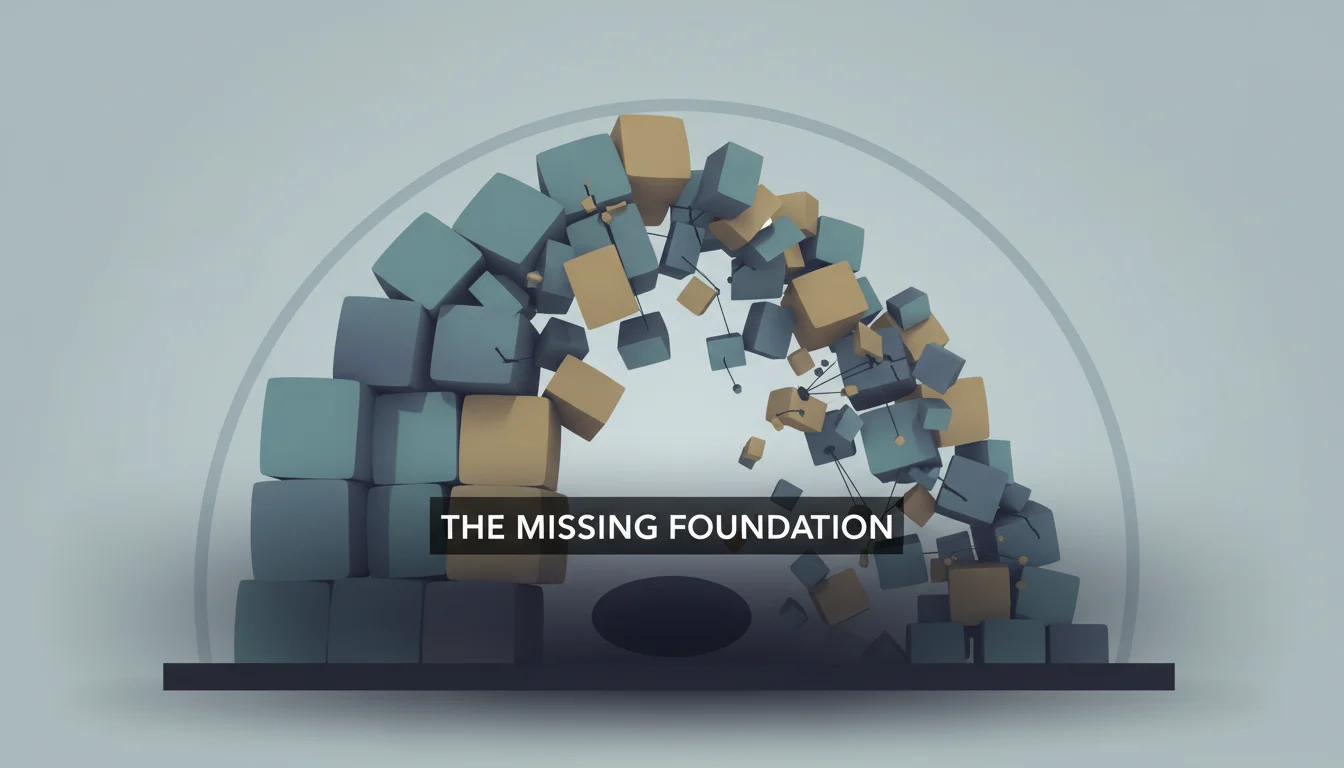
The Problem Was Not the Software: It Was What You Built Before You Started Building
Most automation projects fail quietly.
They launch with optimism. They work, technically. The software does what it was designed to do. Notifications go out. Tasks get created. Data moves from one place to another.
But six months later, no one uses it. In the worse case, everyone uses it and wishes they did not.
The automation created more work instead of less. It introduced new problems instead of solving old ones. It became something the team works around instead of something that helps.
The tools were fine. The diagnosis was missing.
Automation fails when you skip the audit. When you build before you understand. When you assume you know what needs to be automated without validating that assumption.
The failures are predictable. They happen slowly enough that no one connects them back to the original decision.
Failed Automation Stories
Consider the automation that “worked” but did not help.
A sales team automated lead routing. Every time a form was submitted, a lead was assigned to the next person in rotation. The system was fair. It distributed work evenly.
But it ignored context. High-value leads went to whoever was next, regardless of whether they had experience with that industry. Urgent leads sat in queues because the system had no prioritization logic. The automation created equality at the cost of effectiveness.
The team kept using it because turning it off felt worse than living with it. But no one was happy. The automation made a structural problem harder to see.
Or consider the automation that introduced new bottlenecks.
A marketing team automated content approvals. Every draft triggered a notification to the approver. The approver reviewed it and sent it to the next stage. On paper, this created accountability and speed.
In practice, it created a single point of failure. The approver became a bottleneck. If they were unavailable, everything stopped. The automation removed flexibility instead of adding it.
Cases like these are the norm. Most automation projects succeed technically but fail operationally because they were designed without understanding the system they were meant to improve.
What an Audit Found Before Anyone Built Anything
In an operations audit I performed for a performance ad agency, the founder and three team members each named the same stretch without prompting, the time from signed agreement to live campaign. Work stalled in two places. Clients were slow to send their assets, and scripts sat waiting on client approval.
Both stalls were about following up with clients, not about making content faster. A tool that sped up editing or script writing would have been built well and changed nothing in that first stretch.
So the recommendation went at the stall. When a client signs, create their intake folder and task board, send the asset request, and nudge them on a schedule until assets and approvals arrive. That automation is simple and fits the problem because the audit found the problem first.
The same audit found something that automation alone would have made worse. The team met for 15 minutes every day to review a client tracker, and the plan was to turn what came up into Asana tasks. The client success manager rated how often that happened at 3 out of 10. Automating the next step before fixing that habit would have produced tasks nobody trusted.
Why Automation Fails Before It Starts
Automation fails for three reasons, and all of them happen before a single workflow gets built.
The first is bad inputs.
Automation does not fix bad data. It scales it. If your CRM has duplicate records, automating outreach will send duplicate emails. If your task system has vague descriptions, automating task creation will create vague tasks faster.
Software does not turn bad inputs into good outputs. They become bad outputs at scale.
The second reason is undefined ownership.
Who is responsible when the automation breaks? Who updates it when requirements change? Who monitors it to make sure it is still doing what it should?
Most teams assume someone will figure this out later. Later never comes. The automation drifts. It stops matching reality. Eventually it becomes a black box that no one understands and everyone fears changing.
The third reason is unclear success criteria.
What does success look like? Is it speed, accuracy, consistency, or something else? How will you measure whether the automation is working?
Without clear criteria, automation becomes a solution in search of a problem. It gets built because it seems useful, not because it solves a specific, measurable issue.
These problems are invisible during implementation. They only surface later, when the automation is live and the cost of changing it is high.
What an Audit Actually Prevents
An audit exists to help you understand the system before you change it.
When you audit a process, you are asking questions most teams skip.
How does this work today? Where does it break? What decisions require judgment and what decisions are mechanical? What information needs to flow for the process to succeed?
An audit surfaces the hidden complexity that automation will inherit.
It reveals misaligned expectations. One person thinks the goal is speed. Another thinks it is accuracy. Without alignment, the automation will satisfy one group and frustrate the other.
It identifies edge cases. Automation handles the happy path well. It struggles with exceptions. An audit helps you decide whether to automate around edge cases, handle them manually, or redesign the process to reduce their frequency.
It clarifies dependencies. What other systems does this process touch? What breaks if you change how information flows? What assumptions are baked into the current workflow that automation might violate?
The answers separate automation that helps from automation that creates new problems.
Audit vs Implementation
Diagnosis and execution are different skills.
Implementation is about building something that works. Diagnosis is about understanding what needs to be built and why.
Most businesses skip diagnosis because implementation feels more productive. You can see progress. You can show stakeholders that something is happening.
But skipping diagnosis always costs more in the long run.
You build the wrong thing, or you build the right thing in the wrong way. You create technical debt. You automate around problems instead of solving them. You scale inefficiency instead of eliminating it.
An audit forces you to slow down and think before you act. It creates the clarity that makes implementation faster and more effective.
When you audit first, you build less. You automate only what needs to be automated. You design for the system instead of for individual tasks.
This feels slower upfront. It is faster over time.
The Quiet Failures No One Talks About
The most dangerous automation failures are the ones that do not look like failures.
The automation runs. No one complains loudly. Work continues to happen. But underneath, the business is less efficient than it was before.
People spend time working around the automation instead of with it. They develop workarounds that bypass the system. They stop trusting it to handle important work.
These failures do not show up in dashboards. They show up as frustration, inefficiency, and missed opportunities.
An audit prevents these quiet failures by surfacing misalignment before it gets encoded into software.
It asks whether the problem is worth solving. It validates that the proposed solution actually addresses the root cause. It ensures that automation will support the team instead of constraining them.
The goal is to avoid predictable mistakes.
Why Marketing Automation Fails in Small Businesses
Marketing automation is the case I see most often in small firms. The failure usually traces back to the three causes above.
The contact list has duplicates, so the same lead gets the same sequence twice. Nobody owns the sequences, so they keep sending after the offer or pricing has changed. And no one defined what a good result looks like, so open rates get treated as success while no one checks whether the emails produce booked calls.
A short audit of the list, the owner and the target result before you build any sequence prevents most of this.
What Is the Problem With Automation?
Automation repeats whatever process you give it. If the process is unclear, unowned or aimed at the wrong goal, the software repeats that faithfully and faster.
That is why a lead routing rule or an approval flow can run without errors and still make the business worse. The software did its job. The process underneath it was never examined.
Where to Start
If you are considering automation, start with an audit.
Understand the current state before you design the future state. Map the workflow. Identify what works and what does not. Talk to the people who do the work and the people who depend on it.
Ask whether the problem is really automation, or whether it is structure, clarity, or alignment. Automation cannot fix those things. It can only amplify what is already there.
If you want a framework for thinking through operations, start with Automation Architecture for Small Teams. If you want help finding where automation fits in your business and where it does not, the free process audit maps your top 3 processes and prices your top 5 automation opportunities in dollars.
Automation fails when you skip the audit. It succeeds when you take the time to understand what you are building and why.
The difference is not the tools. The difference is whether you start with diagnosis or jump straight to execution.
Do the audit. The automation will be better for it.
Related reading: Automation Architecture for Small Teams · Automation as Business Philosophy