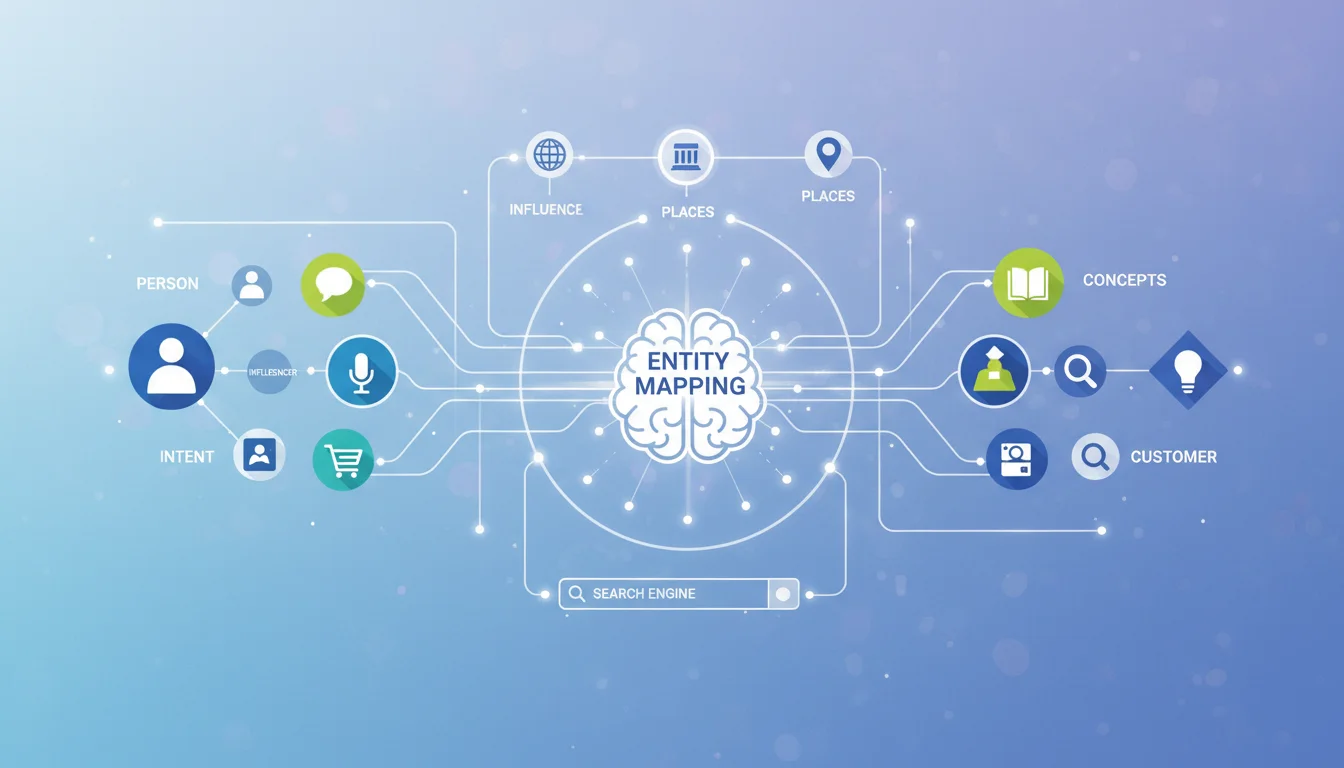
Keywords tell search engines what you said. Entities tell them what you mean.
Search engines have evolved far beyond matching keywords. Google and other major platforms now process information the way humans do, by understanding relationships between people, places, organizations, and concepts. This shift makes entity mapping a fundamental part of modern SEO strategy.
If your content marketing still focuses primarily on keywords, you’re working with an outdated playbook. Entity-based optimization helps search engines grasp the full context of your content, which can improve your visibility across multiple search features.
What Entity Mapping Actually Means
Entity mapping is the process of identifying and connecting related concepts within your content ecosystem. An entity can be anything with a distinct identity: a person like Marie Curie, a place like the Louvre Museum, or a concept like machine learning.
The mapping part refers to how these entities relate to each other. When you create content about artificial intelligence, you’re naturally touching on related entities like neural networks, training data, and algorithmic bias. Search engines use these relationships to understand what your content covers and how authoritative you are on the topic.
Think of it as teaching search engines the context around your content. They can see beyond isolated keywords and recognize that your article about startup fundraising connects to entities like venture capital, term sheets, and dilution.
Why Traditional Keyword Optimization Falls Short
Keywords still matter, but they only tell part of the story. If someone searches for “apple nutrition facts,” a keyword-focused approach might struggle to distinguish whether the query relates to the fruit or tech company news about employee health programs.
Entity-based search solves this ambiguity problem. Search engines analyze the surrounding context, user search history, and related entities to deliver accurate results. They understand that “apple” appearing alongside “vitamin C” and “fiber” refers to the fruit, while “apple” with “Tim Cook” and “iPhone” refers to the company.
This contextual understanding means your content needs to demonstrate clear entity relationships. A page about content marketing should naturally reference related entities like audience research, editorial calendars, and distribution channels. Missing these connections can signal incomplete coverage.
How Search Engines Build Knowledge Graphs
Google maintains a massive knowledge graph containing billions of entities and their relationships. When you search for “who directed Inception,” Google queries its knowledge graph to find the entity relationship between the movie Inception and director Christopher Nolan, then returns the answer.
Your content feeds into this knowledge graph. When you publish an article and use schema markup to identify entities, you help search engines understand what you’re discussing and how those concepts connect. Over time, consistent entity coverage in a topic area can establish your site as an authoritative source.
The knowledge graph influences multiple search features. Featured snippets, knowledge panels, and related questions all draw from entity relationships. Sites with strong entity mapping tend to appear more frequently in these enhanced results.
The Four Core Benefits of Entity Mapping
Better entity mapping directly impacts your search performance in measurable ways. Here’s what typically improves when you implement an entity-focused strategy.
Enhanced Search Rankings
Search engines reward content that demonstrates deep understanding of a topic. When your articles consistently cover related entities and show clear relationships between concepts, you signal topical expertise.
This doesn’t mean stuffing your content with every remotely related term. It means naturally addressing the subtopics, questions, and concepts that logically connect to your main subject. An article about email deliverability should probably touch on entities like SPF records, DMARC policies, and reputation monitoring.
Stronger Topical Authority
Entity mapping helps you build topical clusters that reinforce your authority. When you create content covering multiple related entities within a subject area, search engines recognize your site as a complete resource.
For example, a site publishing about web performance might cover entities like Core Web Vitals, lazy loading, content delivery networks, and browser caching. These interconnected pieces demonstrate domain expertise more effectively than isolated articles.
Voice Search Optimization
Voice queries tend to be conversational and context-dependent. Someone might ask “what’s the best way to remove red wine stains from cotton” when they would have typed “remove wine stains cotton.” Entity-based content naturally aligns with these longer, more specific queries.
When your content covers entities and their relationships thoroughly, you’re more likely to match the semantic intent behind voice searches. This matters increasingly as voice assistants become a primary search interface.
Rich Result Eligibility
Knowledge panels, featured snippets, and people also ask boxes all rely heavily on entity data. Proper entity markup using schema.org vocabulary makes your content eligible for these prominent placements.
A recipe page with proper schema markup for ingredients, cooking time, and nutritional information becomes eligible for rich recipe cards. A local business with complete entity data about location, hours, and services can appear in Google’s local pack.
Implementing Entity Mapping: A Practical Framework
Moving from theory to practice requires a systematic approach. Here’s how to integrate entity mapping into your content operations.
Step 1: Identify Your Core Entities
Start by mapping the primary entities relevant to your business or content focus. These typically include your products, services, founders, locations, and main topic areas.
For a SaaS company, core entities might include your product features, integration partners, target industries, and common use cases. A local service business would focus on service types, geographic areas, and relevant certifications or expertise.
Document these entities in a spreadsheet or knowledge base. Include variations and synonyms that people might use. “Search engine optimization,” “SEO,” and “organic search” all refer to the same entity but appear in different contexts.
Step 2: Entity Relationship Mapping
Once you have your core entities identified, document how they connect. Which entities frequently appear together? What hierarchical relationships exist? Which concepts serve as bridges between different topic areas?
These relationships become your content architecture. If you publish content about email marketing, you might naturally cover related entities like list segmentation, automation workflows, and deliverability. Each of these connects to additional sub-entities that create a complete topic map.
Step 3: Implement Schema Markup
Schema markup provides explicit signals about entities on your pages. While search engines can infer many relationships from content alone, structured data removes ambiguity.
Use schema.org vocabulary to mark up relevant entities. An article might include Article schema with author and publisher information. A product page should include Product schema with pricing, availability, and review data.
Focus on the schema types most relevant to your content. Local businesses benefit heavily from LocalBusiness schema. Publishers should prioritize Article, NewsArticle, and BreadcrumbList schema.
Step 4: Build Strategic Internal Links
Internal linking reinforces entity relationships. When you link from a page about content strategy to a page about audience research, you’re telling search engines these entities connect.
Use descriptive anchor text that includes entity names or variations. Instead of “click here,” use “learn more about editorial workflow management” or “see our guide to content distribution channels.” This provides additional context about entity relationships.
Create hub pages that serve as central resources for major entity clusters. These pages link to related subtopic pages, creating a clear hierarchical structure that search engines can easily map.
Step 5: Monitor Entity Performance
Track how your entity-focused content performs in search. Look beyond basic rankings to examine rich result appearances, featured snippet captures, and knowledge panel associations.
Google Search Console shows which queries trigger featured snippets and how often users click through. Monitor these to understand which entity relationships work for searchers.
Review your content periodically and check that entity coverage is still current. New related entities emerge as industries evolve. Search trends reveal which entity relationships users care about most.
Entity Mapping Questions
What Is Entity Mapping in SEO?
Entity mapping SEO work means listing the people, places, products, and concepts your business covers, then documenting how they connect. Your content, internal links, and schema markup then reflect those connections.
What Is an Example of Data Mapping?
In data mapping, a field in one system gets matched to the field in another. “Customer Name” in your CRM maps to “Contact” in your email tool. Entity mapping works the same way for content. Each concept maps to a page, and each relationship maps to a link or a schema property.
What Is an Example of Entity Relationship Mapping?
Take a bookkeeping firm that serves restaurants in Austin. The entities are the firm, the owner, Austin, restaurant bookkeeping, payroll, and sales tax. The relationships are simple: the owner runs the firm, the firm serves restaurants in Austin, and payroll is one of its services. Each relationship becomes a page, an internal link, or a schema property.
Common Entity Mapping Mistakes
Even experienced SEO practitioners can stumble with entity implementation. Watch for these frequent issues.
Overstuffing content with entity mentions feels mechanical and hurts readability. Entities should appear naturally within the flow of your content, not inserted awkwardly to check boxes.
Ignoring entity variations creates gaps in coverage. Search engines understand synonyms, but your content should still address the terms your audience actually uses. Technical documentation might reference “authentication protocols” while users search for “how to log in securely.”
Weak internal linking structure undermines entity relationships. If you never link between related entity pages, you’re missing opportunities to reinforce topical connections.
Moving Forward With Entity-Based SEO
Entity mapping represents a fundamental shift in how search engines evaluate content quality and relevance. The sites that will thrive in search are those that demonstrate deep understanding of their subject areas through well-connected entity relationships.
Start small if this approach feels overwhelming. Pick one core topic area and map the related entities thoroughly. Create or update content to cover those relationships clearly. Implement appropriate schema markup. Then expand to adjacent topic areas.
The investment pays off through improved visibility, better user engagement, and sustainable organic growth. Search engines will continue moving toward more sophisticated entity understanding, so this work is worth more over time.
Related reading: AI Enabled SEO Operations · The Best Schema Markup Types for SEO
If you are ready to operationalize your SEO, the SEO accelerator builds the operational layer.