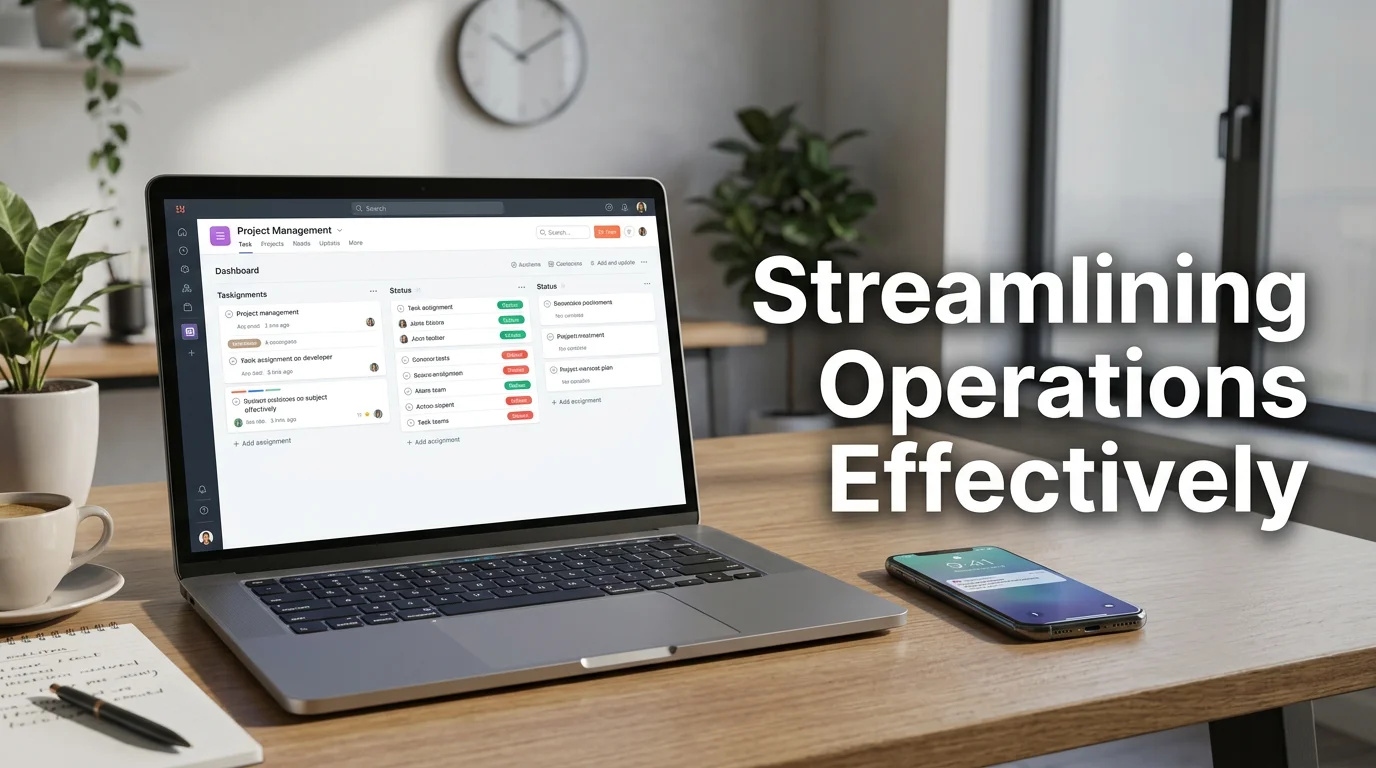
Most Operations Work Does Not Need a Person: It Needs a System
The conventional wisdom says that once your business reaches a certain size, you hire an operations manager. They own the workflows, manage the coordination, handle the follow-up, and make sure nothing falls through the cracks. You get your time back.
For most businesses between $1M and $5M, that hire is not happening anytime soon. The question is not when to bring in an ops manager. The question is what you build in the meantime: and whether you even need one when it comes time to decide.
The answer depends on a distinction most founders miss: the difference between operations work that requires judgment and operations work that requires coordination. One needs a person. The other needs a system.
Founders run operations without an ops manager by handing the coordination work to systems and keeping the judgment calls for themselves.
What an Operations Manager Actually Does
To decide what can be replaced, you need to understand what the role actually contains.
An operations manager handles four categories of work:
Coordination: Moving information between people and systems. Status updates, task handoffs, follow-up reminders, routing new requests to the right owner.
Oversight: Monitoring what is on track, what is behind, and what is at risk. Keeping a live view of delivery and surfacing what needs attention before it becomes a problem.
Process enforcement: Making sure the team follows the actual procedure rather than improvising. Running checklists, verifying deliverables, catching skipped steps before they cascade.
Exception handling: Identifying what falls outside the normal flow and routing it to someone with the authority to decide.
Three of these four categories are largely systematic. Coordination, oversight, and process enforcement can be handled by well-designed automation and tooling. Exception handling is the category that requires a person: because exceptions, by definition, are the things a system cannot predict.
Most small businesses are overwhelmed by coordination work. They mistake it for an ops problem that needs a hire. It is a systems problem that needs architecture.
Where Systems Can Take Over
AI and automation tools have matured to the point where the coordination layer is largely solvable without a person.
Intake and routing: A structured intake form that feeds your project management system can receive a new request, create a task, assign an owner, set a due date, and notify the right people, all without anyone touching it manually.
Status updates and check-ins: Workflow automation tools can trigger scheduled check-ins, pull task status from your project system, and surface what needs attention without anyone asking. No more chasing for updates.
Follow-up sequences: Whether it is a client onboarding flow, a proposal follow-up, or an internal approval chain, automated sequences run reliably and consistently. They do not forget. They do not get busy.
Dashboard visibility: Instead of someone compiling a weekly status report by hand, an operations dashboard pulls live data and shows you the picture in real time. The AI Operations Dashboard for Founders model eliminates the majority of manual reporting overhead.
Recurring process checklists: Tools like ClickUp, Notion, or Process Street can trigger recurring checklists automatically, so the right steps get followed on every engagement without someone manually initializing the process.
This is not theoretical. Businesses running on five to fifteen people are operating this way today. The infrastructure exists. What most teams are missing is the architecture that connects it into a coherent system rather than a collection of disconnected tools.
For a practical view of how to sequence the build, How to Automate Your Business Operations with AI covers the approach in detail.
What Only You Can Own
Systems take over the coordination overhead that has been consuming your judgment, and leave the judgment calls with you.
There are things that remain founder work regardless of how sophisticated your automation becomes:
- Decisions that require context only you have: client relationships, strategic direction, team dynamics
- Responses to situations that fall completely outside any defined process
- Judgment calls where the right answer depends on nuance no system captures
- The ongoing work of deciding what the process should be
The goal is not to automate your role. The goal is to automate the work that has been eating your role. When coordination overhead disappears, what remains is almost entirely judgment work: the kind of work that actually requires you.
Most founders who describe themselves as buried in operations are buried in follow-up emails, status checks, and process coordination that has no business sitting in their calendar. That is a solvable structural problem.
Building the Minimal Viable Ops Stack
You do not need an enterprise platform. For a team of five to twenty-five people, a functional ops architecture has five components:
A single source of truth: One project management tool where every active project and task lives. Not three tools that partially overlap. Pick one and enforce it. Fragmented visibility is the root cause of most coordination overhead.
A structured intake system: A form or defined process for how new work enters the system. Every request gets routed, assigned, and tracked from the moment it comes in: not after someone notices it is sitting in an inbox.
An automation layer: A tool like n8n or Make connecting your systems so that when something changes in one place, the appropriate things happen in the others. New client signed ? onboarding task created. Project marked complete ? invoice triggered. These connections compound over time.
A live ops dashboard: One view that shows what is overdue, what is at risk, and what needs a decision today. Not a report you build weekly: a view that is always current.
A communication protocol: A shared standard for where updates live, how urgent issues get escalated, and what counts as a decision versus a status update. Without this, the tools do not hold.
Building this takes most small teams four to eight weeks. Stabilizing it takes another two to three months of iteration. Once it is running, it handles the majority of what a junior operations manager would otherwise own.
The AI Automation Stack for Small Businesses covers the tooling decisions in more detail, including how to avoid building a stack that works in theory and breaks in practice.
The Coordination Tax
There is a cost to running without systems that most founders do not calculate.
Every hour you spend on coordination (following up on tasks, compiling status, chasing approvals, routing requests) is an hour not spent on the work that moves the business. For most founders in the $1M to $3M range, that coordination tax runs between eight and fifteen hours per week.
At ten hours per week, that is roughly a quarter of a standard working week spent on work a system could do. Over a year, that compounds into thousands of hours of capacity that was never deployed on anything strategic.
Systems do not cost money in the way a hire does. They cost setup time and discipline. The return on that investment is recoverable capacity: and that capacity is what scaling actually requires.
When You Actually Do Need to Hire
Systems cover a lot. They do not cover everything.
There are conditions where an operations hire makes genuine sense:
- Your exception volume is high enough that managing exceptions has become a full-time function in itself
- Your team has grown beyond twenty-five people and coordination complexity has outpaced what automated tooling handles well
- You are running multiple distinct service lines, each with their own delivery processes and accountability structures
- The judgment layer of your operations is breaking down regularly: not the coordination layer, but the actual decision-making
At that point, you are not hiring someone to send follow-up emails or compile reports. You are hiring someone to own the exception layer, align systems with strategy, and make judgment calls at volume. That is a meaningfully different role, and a more defensible investment.
Most businesses at the $1M to $5M level are still drowning in coordination work that should have been systematized two years ago.
Build the System Before the Hire
Hiring before you have a system does not solve an operations problem. It adds a person to an operation that does not have the infrastructure to support them. The work still falls through the cracks: it just gets handed off to someone who is also overwhelmed.
Build the architecture first. Get the intake, the dashboard, and the automation layer running. Give it time to stabilize. Then evaluate whether the remaining work (the actual judgment calls) justifies a dedicated person.
For most businesses in this range, the system can carry significantly more than they expect. The hire becomes a strategic decision rather than a survival response.
If you are not sure where your operation stands, an AI operations audit will identify which parts of your workflow are ready to be systematized and where the real gaps are.
Related reading: Signs Your Business Needs AI Operations | AI Operations for Small Businesses: The Complete Guide