Search Has a New Surface Area: Here Is What Changes and What Stays the Same
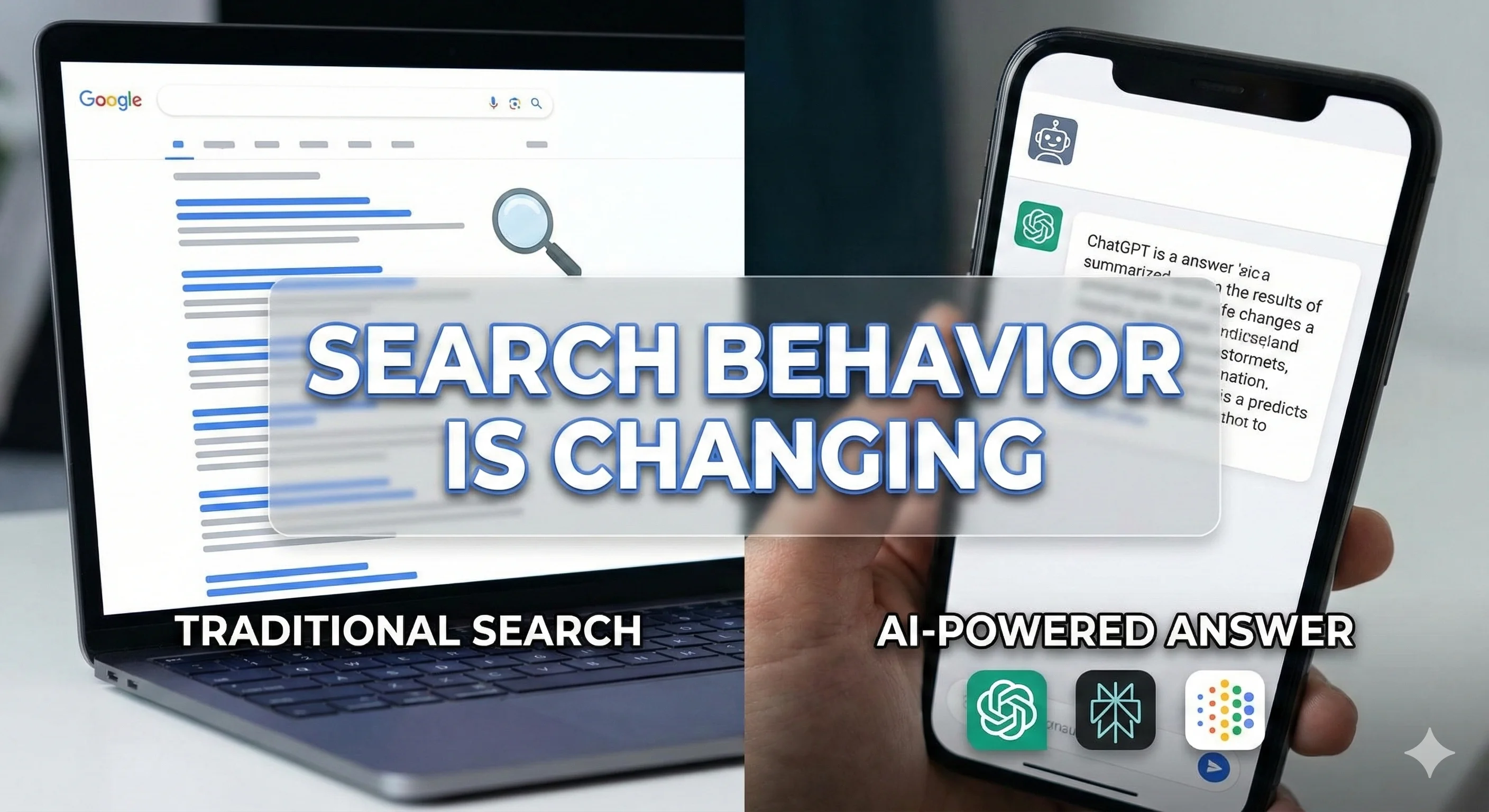
Search behavior is changing. A growing portion of information queries are now answered directly by AI tools instead of a list of links. Users ask ChatGPT a question and get a synthesized answer. They use Perplexity to research a topic and receive a cited summary. They type a query into Google and find a generated response above all organic results.
This does not mean traditional SEO is obsolete. It means the surface area of search has expanded, and the signals that determine visibility in AI-generated responses are meaningfully different from the signals that determine rank position in a standard SERP.
Understanding those differences is increasingly relevant for any content-driven business that depends on organic search for visibility and leads.
How AI Search Differs From Traditional Search
In traditional search, Google crawls and indexes content, then ranks pages against a query using hundreds of factors: relevance, authority, page experience, and more. A user clicks a link and reads the source content.
In AI search, a language model retrieves and synthesizes content from multiple sources to generate a direct answer. The user often does not visit the source at all. The model constructs a response, and whether your content is represented in it depends on different factors.
There are three distinct environments worth understanding.
Google AI Overviews are generated responses that appear at the top of Google search results for many informational queries. They pull from indexed web content and cite sources. Traditional SEO signals still matter here, but content structure, clarity of answer, and authoritativeness carry additional weight.
Perplexity is an AI search engine that retrieves content from the live web and synthesizes answers with citations. It prioritizes sources that are clearly authoritative, well-structured, and easy to extract specific answers from. Content that answers questions directly and cites supporting evidence tends to perform well.
ChatGPT with browsing enabled retrieves content from the web to answer queries in real time. Without browsing, it draws on its training data, which means older or very new content may not be represented. For most business SEO purposes, the browsing-enabled behavior is the more relevant consideration.
What AI Search Tools Prioritize
Despite their differences, the three environments share a set of preferences.
Direct, answer-forward structure. AI models are trying to extract answers efficiently. Content that buries its main point in a long introduction, uses vague language, or favors narrative flow over clear sections is harder for AI to use. Content that states its answer clearly near the top, uses descriptive headers, and organizes information in discrete sections is easier to retrieve and cite.
Entity coverage and semantic depth. AI models look at the entities and concepts a page covers as well as its keywords. An article on a topic that covers the main concepts, relationships, and implications of that topic thoroughly is more likely to be treated as authoritative than an article that covers the surface level. This is the same principle that drives topical authority in traditional SEO, applied with more nuance.
Source authority and E-E-A-T signals. Experience, expertise, authoritativeness, and trustworthiness are the signals Google has been building toward for years, and they are central to what AI search tools use to evaluate credibility. Content attributed to a named author with demonstrated expertise, published on a domain with consistent topical focus, and supported by citations to credible external sources, carries more weight than anonymous content on a general-interest site.
Citation-worthy sourcing. Perplexity and AI Overviews both cite their sources. Content that itself cites credible research, data, or authoritative sources is more likely to be treated as a reliable reference. Sourcing claims with links to authoritative external documents also works as an optimization signal for AI-generated search results.
What Stays the Same
The fundamentals of strong SEO content do not become irrelevant in an AI search environment. They become more important.
Topical authority still matters. A site that covers a subject comprehensively, with well-structured cluster content and strong internal linking, signals to both search engines and AI retrieval systems that it is a reliable source on that topic.
Technical SEO still matters. AI tools can only use content they can access and parse. Pages that load slowly, have poor structure, or block crawling cannot be retrieved or cited.
Content quality still matters. Generic, thin, or repetitive content does not serve AI search users any better than it serves traditional search users. The bar for what constitutes useful content is rising, not falling.
The shift moves from optimizing primarily for rank position toward optimizing for representation in synthesized responses. The underlying requirement is the same: produce content that is useful, clearly structured, and demonstrably authoritative.
Practical Changes to Make Now
Structure content to answer questions directly. Use headers that reflect the specific questions a searcher might ask. Follow each header with a clear, complete answer in the first paragraph of that section. The rest of the section can provide depth and context, but the direct answer should come first.
Increase citation density. Link to authoritative external sources to support specific claims, data points, and frameworks. This is a source context optimization that signals credibility to AI retrieval systems in the same way it signals credibility to human readers.
Make authorship visible. If content is attributed to a named individual, that individual’s credentials and expertise should be visible somewhere on the site. Author pages, byline information, and linked professional profiles all contribute to E-E-A-T signals.
Cover topics thoroughly within their scope. An article that covers its topic with genuine depth, including the adjacent concepts and implications that a knowledgeable practitioner would naturally address, performs better in AI search than a well-optimized article that stays at surface level.
Use structured data. Schema markup for Article, FAQ, HowTo, and other content types helps AI systems understand what kind of content they are looking at and what questions it addresses. This is a signal worth maintaining even as AI search evolves.
SEO for AI Search Questions
What Is SEO for AI Search Called?
Two names are in use. GEO stands for generative engine optimization. AEO stands for answer engine optimization.
So when someone asks what GEO is in SEO, it means optimizing your content so generative tools cite or mention it. AEO means shaping your content so it becomes the direct answer to a question. Both sit on top of regular SEO.
Does SEO Still Apply to AI? Is It Still Worth It?
Yes. Is SEO still relevant for generative AI search? The sources behind AI answers are still crawled, indexed, and judged for authority. A page that search engines cannot access or trust has little chance of being cited.
How Do You Do SEO for AI Search?
Start with the sections above. Put the answer first under each header, cite credible sources, show who wrote the content, and add schema markup. Make sure your pages load fast and can be crawled.
For SEO for AI Overviews, the same steps apply because Overviews pull from indexed content. To optimize your website for AI search results, check your most important pages one at a time against that list.
SEO AI tools and AI search optimization tools can speed up research and drafting. They do not decide whether an AI Overview or Perplexity cites you. Your content does.
The Bigger Picture
AI search changes what good SEO produces as an outcome, and the need for SEO expertise stays.
The goal is no longer only to appear in position one for a set of target keywords, though that still matters. The goal is also to be the source that AI tools cite when they answer questions in your topic area. That requires the same foundation: topical authority, quality content, structural clarity, and credible sourcing.
The firms that invest in building that foundation now will have a natural advantage as AI search continues to mature, regardless of how the specific platforms and ranking mechanisms evolve.
Related reading: AI Enabled SEO Operations: The 6 Layers of SEO Success · The Modern SEO Imperative of Source Context
Ready to build a content and SEO system designed for how search works now? Explore the SEO Accelerator.