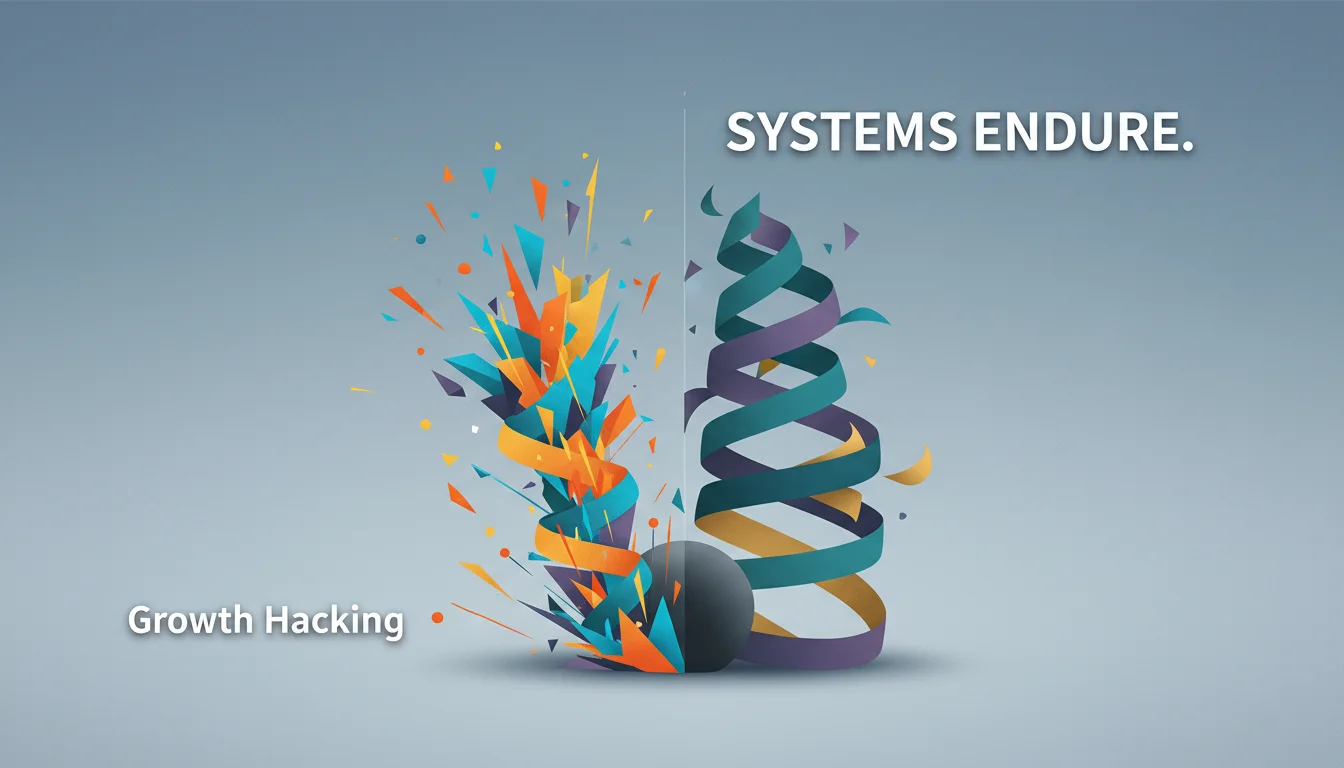
Past $1M, throughput is the bottleneck.
Growth hacking works until it does not.
In the early stages, speed and scrappiness create momentum. You find a channel that works and you exploit it. You move fast, test constantly, and optimize for quick wins. The business grows because you outwork the problem.
Then you cross a million in revenue and something changes.
The tactics that got you here stop working. Growth slows. The team feels stretched. Operations feel chaotic. What used to be exciting starts to feel exhausting.
The constraints changed.
After $1M ARR, coordination becomes the bottleneck. Systemic thinking replaces growth hacking as the skill that matters most.
Growth Hacking’s Expiration Date
Growth hacking is optimized for zero to one.
It thrives in environments where the primary constraint is traction. You need users, revenue, or proof that the business can work. Speed matters more than sustainability. Iteration matters more than structure.
The tactics reflect this. You run experiments. You test channels. You optimize conversion funnels. You find hacks that create disproportionate results with minimal resources.
This works because the system is simple. The team is small. Everyone knows what is happening. Decisions get made fast. If something breaks, you fix it and move on.
But as the business grows, the system becomes complex.
You have more customers with different needs. You have more team members with different responsibilities. You have more processes, tools, and dependencies. What used to be simple becomes layered.
Growth hacking assumes simplicity. It breaks down when complexity increases.
The tactics still work in isolation. You can still optimize a landing page or test a new channel. But the impact is smaller because the system resists change. Coordination overhead consumes the gains. Quick wins create technical or operational debt that slows you down later.
After $1M ARR, the constraint is throughput. You need the business to handle more volume without collapsing under its own weight.
Why Growth Tactics Fail at Scale
Growth tactics fail at scale for three reasons.
The first is fragile systems.
Growth hacking prioritizes speed over resilience. You build the minimum viable version of everything. Processes are informal. Tools are loosely connected. Knowledge lives in people’s heads instead of in documentation.
This works when the team is small and proximity creates shared context. It fails when the team grows and proximity disappears.
Fragile systems do not break all at once. They degrade slowly. Work takes longer. Mistakes happen more often. People spend time fixing problems that should not exist.
The second reason is team overload.
Growth hacking assumes everyone can do everything. In a small team, this creates flexibility. In a larger team, it creates chaos.
People take on too many roles. Priorities conflict. Important work gets delayed because someone is fighting fires. Burnout becomes the norm instead of the exception.
The team grows, but capacity does not increase proportionally because coordination consumes the gains.
The third reason is invisible costs.
Growth hacking optimizes for visible wins. Revenue, users, conversions. These metrics are easy to track and celebrate.
But they hide costs. Technical debt that slows down product development. Operational debt that creates manual work. Customer success debt that turns early wins into long-term liabilities.
These costs accumulate quietly. By the time they become visible, they are expensive to fix.
What Systemic Thinking Replaces
Systemic thinking changes how you pursue growth.
Where growth hacking optimizes for spikes, systemic thinking optimizes for sustainable throughput. Where growth hacking prioritizes velocity, systemic thinking prioritizes stability. Where growth hacking focuses on tactics, systemic thinking focuses on structure.
The shift is fundamental.
You stop asking “what tactic will create the next win” and start asking “what system will support consistent growth.” You stop celebrating heroics and start building processes that do not require heroism. You stop optimizing individual actions and start optimizing how work flows through the business.
You can still move fast. The foundation is what lets you keep that speed.
Systemic thinking replaces fragility with resilience. It creates systems that can handle complexity without breaking. It distributes knowledge so losing one person does not create a crisis. It makes work repeatable so you can scale without reinventing everything.
Each fix also pays off more than once. When you fix a systemic problem, you improve everything downstream. When you fix a tactical problem, you improve one thing.
What Changes After $1M
After $1M ARR, the business is the system that delivers the product.
Early-stage businesses can rely on founders to hold everything together. Post-$1M businesses need structure that holds itself together.
The constraints change.
You can no longer communicate through proximity. You need clarity in writing. You can no longer make decisions by consensus. You need defined ownership. You can no longer rely on shared context. You need documentation and process.
Coordination becomes the bottleneck. The limiting factor is how well multiple people can work together.
This is where systemic thinking creates value.
It designs for handoffs. It makes dependencies explicit. It removes friction from the places where work moves between people or stages. It creates clarity so people can make decisions without constant escalation.
Systems outperform hustle at this stage.
You cannot hustle your way through coordination problems. You cannot work harder to fix structural issues. You need to redesign how work happens so it does not require constant intervention.
This is uncomfortable. It requires slowing down to speed up. It requires investing in things that do not show immediate results. It requires admitting that the tactics that got you here will not get you to the next stage.
But it is necessary.
Businesses that try to scale on hustle eventually collapse. Businesses that invest in systems create sustainable capacity.
Building for Throughput
The difference between growth and throughput is subtle but important.
Growth is about increasing revenue. Throughput is about increasing capacity to deliver value consistently.
You can grow by adding more people, taking on more customers, or expanding into new channels. But if your systems cannot handle the increased complexity, growth creates chaos instead of progress.
Throughput is about making the system more efficient. It is about reducing bottlenecks, eliminating waste, and improving coordination. It is about building capacity that scales without requiring proportional increases in resources.
Systemic thinking focuses on throughput. It asks how to deliver more value with the same or fewer inputs. It optimizes for the long term, not the next quarter.
Growth still matters. The goal is growth you can sustain.
What This Looked Like in an Agency I Audited
I audited a performance ad agency doing about $1M a year with 5 core staff. Growth was not the problem. Referrals kept coming. The problem was where decisions went once they arrived.
The founder answered everything. He was never slow to reply and never hard to reach. That was the trap. Every question got a good answer within minutes, so nobody on the team ever had a reason to make the call themselves. He also never taught them how he decided. They got the answer without the rule behind it, so the next similar question came back to him.
The cost showed up in small stalls. The agency planned to launch ads for itself in the first quarter. At the end of the quarter they still were not running, because the only person who could write ad copy was busy writing client scripts. Scripts sat waiting on client approval with no one owning the follow-up. The team rated their own documentation 4 out of 10.
No growth tactic fixes that. More leads would have landed in the same queue.
What I recommended was unglamorous. Write down which decisions the team can make without asking, and the rule the founder uses for each one. Give operations a named owner. Then answer a question by pointing at the rule, not by solving it again.
Past $1M, one of the most useful systems you can build is a short list of decisions your team no longer needs you for.
What Is Systems Thinking?
Systems thinking is a way of looking at a business as a set of connected parts. You ask how work flows between people, tools and steps, and you fix the connections instead of one task at a time.
In simple words, it means asking “what is causing this problem to keep coming back?” before you reach for another quick fix. Systemic thinking and systems thinking mean the same thing here.
What Kind of People Are Systems Thinkers?
They tend to be the people who notice where work stalls between two teams, who ask why the same mistake happens every month, and who write things down so the process survives when someone leaves. Founders often have this skill and stop using it while they are busy hustling.
How Do You Learn Systems Thinking?
Start with one process in your own business. Map each step, mark who hands work to whom, and note where it waits. Then change one handoff and watch what happens downstream. Repeat on the next process. That loop teaches more than any course.
Where to Start
If you have crossed $1M ARR and growth feels harder than it should, start by examining your systems.
Look at where work gets stuck. Look at where coordination breaks down. Look at where the team is overloaded by complexity.
Ask what would need to change to double revenue without doubling headcount. The answer is usually better systems.
If you want a framework for these changes, start with Intake and Workflow Systems for Growing Firms. If you want to see where your own business stands, the free process audit maps your top 3 processes and prices your top 5 automation opportunities in dollars.
Growth hacking has an expiration date. After $1M ARR, systemic thinking is what separates businesses that scale from businesses that stall.
The earlier you make the shift, the smoother the transition. The longer you wait, the more painful it becomes.
Related reading: Intake and Workflow Systems for Growing Firms | How Smart Companies Standardize LLM Use Across Departments