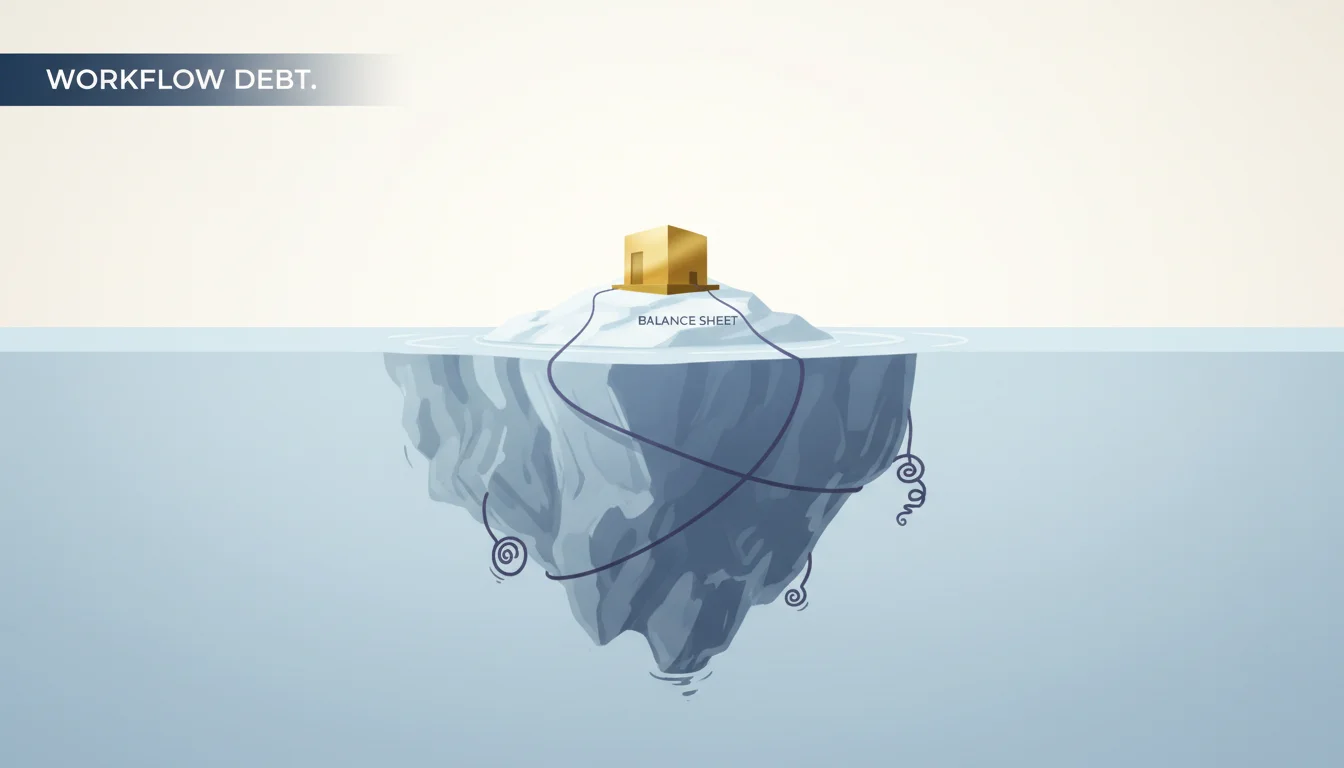
The friction slowing your business down is measurable, and it is costing you real money.
Every business carries debt it does not see on the balance sheet. Not financial debt. Workflow debt.
Workflow debt is the accumulated cost of processes that should work better but do not. The manual tasks that should be automated. The hand-offs that waste time. The legacy systems that constrain how work gets done. The undocumented procedures that exist only in people’s heads.
Like financial debt, workflow debt charges interest. Every week you carry it, you pay a cost in wasted time, errors, frustration, and missed opportunities. Unlike financial debt, workflow debt is invisible. It does not appear on any report. You just feel it in the constant friction of running your business.
Understanding workflow debt, measuring it, and strategically paying it down pays back faster than most projects a growing business can take on.
The Nature of Workflow Debt
Technical debt is a familiar concept in software development. Shortcuts taken during coding create problems that accumulate over time. The quick fix that works today becomes tomorrow’s maintenance nightmare.
Workflow debt follows the same pattern but applies to business operations instead of code.
Every time you solve a process problem with a workaround instead of a real fix, you take on workflow debt. Every time you keep doing something manually because automating it would take time you do not have, you take on workflow debt. Every time a key process lives in someone’s head instead of a documented system, you take on workflow debt.
The debt accumulates quietly. Each individual shortcut seems minor. The compounding effect is what causes damage.
The Four Types of Workflow Debt
Workflow debt takes several forms. Recognizing them helps you identify where your debt concentrates.
Manual debt consists of tasks done by humans that could be done by software. Data entry that could be automated. Reports compiled by hand from information systems already have. Communications sent individually that could be templated and triggered automatically.
Manual debt has direct costs: the time people spend on tasks that add no value. It also has opportunity costs: the work those people could be doing instead.
Shadow debt consists of undocumented, informal processes that exist outside your official systems. The spreadsheet someone maintains because the CRM does not have the right fields. The email folder where critical information lives because there is no better place for it. The knowledge that exists only in one person’s memory.
Shadow debt creates fragility. When the person maintaining the shadow system is unavailable, work stops. When they leave the company, the knowledge goes with them. Shadow processes are also invisible to management, making problems impossible to address until they become crises.
Hand-off debt consists of friction where work moves between people or systems. The re-keying of information from one tool to another. The context lost when a task changes hands. The delays waiting for someone to pass the baton.
Hand-off debt multiplies with scale. Every additional customer, project, or transaction passes through the same friction points. What feels manageable at low volume becomes crushing at higher volume.
Tool debt consists of constraints imposed by systems that no longer fit your needs. The legacy software that cannot integrate with modern tools. The free-tier product you outgrew but never replaced. The spreadsheet that started as a quick solution and became load-bearing infrastructure.
Tool debt limits what is possible. You cannot implement better processes because your tools will not support them. You spend time working around limitations instead of working on what matters.
How Workflow Debt Inhibits Growth
Small businesses often reach a ceiling where growth stalls despite strong demand. The team is working hard. Customers want to buy. But operations cannot scale to meet the opportunity.
Workflow debt is frequently the culprit.
Operational cost scales when it should not. Every new customer requires proportional increases in manual work. Revenue grows but margin shrinks because handling that revenue costs more than it should.
Speed slows at the wrong times. Delivering to customers takes longer. Responding to inquiries takes longer. Making decisions takes longer. Everything that should be getting faster with experience and scale is instead getting slower because processes are clogged.
Quality becomes inconsistent. Manual processes and shadow systems mean results depend on who does the work and how much attention they can give it. Errors increase. Customer experience varies.
Good people leave. Talented employees do not want to spend their time on manual drudgery. They get frustrated with tools that do not work and processes that do not make sense. They leave for companies that have their operations together.
New hires take forever to become productive. Without documented systems, onboarding means learning tribal knowledge through observation and mistakes. The ramp-up period stretches while the new person figures out how things actually work.
These symptoms often get misdiagnosed. Leadership blames the team for not working hard enough, or the market for being difficult, or the economy for creating headwinds. The cause is operational infrastructure that cannot support the business.
What Shadow Debt Looked Like in a 5-Person Agency
In an operations audit I performed for a performance ad agency, the debt did not sit in a broken tool. They had a good one. They used Asana, and Asana held the written steps for how work gets done.
The trouble was that almost nobody opened it. A team member told me the steps were in there, but some of what the team actually did was not, and getting it out of the heads of the two people who knew it was like pulling teeth. Everyone had been there long enough that they did not need the document, so no one kept it up.
The same pattern showed up in the daily meeting. The core team spent 15 minutes every day walking through a client tracker in a Google Sheet. The plan was to turn what came up into Asana tasks afterward. The client success manager rated how often that happened at 3 out of 10, and the founder rated the company’s documentation 4 out of 10.
Nothing was failing, and that is why it stayed hidden. The team told me the work was running smoothly. The risk sat one hire or one departure away. A new person would find a task system that did not match reality, and a person leaving would take the unwritten half with them.
That is shadow debt. You do not find it by looking at your tools. You find it by asking who could cover a key job for a week using only what is written down. In that agency, the honest answer was no.
Workflow Debt vs. Process Debt
Process debt is another name for the same thing. Some teams say process debt when they mean the steps and rules, and workflow debt when they mean the tools and hand-offs that carry those steps. In a 5 to 20 person business the two pile up together, so this post treats them as one.
A hypothetical example is a debt collection workflow. Say a firm chases late invoices by hand. Someone checks the accounting system on Fridays, copies names into a spreadsheet, and writes each reminder from scratch. Nothing is broken, but every overdue invoice costs a person 15 minutes and depends on that person remembering. That is manual debt, hand-off debt, and shadow debt in one process.
Auditing Your Workflow Debt
You cannot pay down debt you have not measured. An audit surfaces where the debt concentrates and quantifies the cost.
Start with an inventory of critical workflows. List the processes that drive your business. Customer acquisition. Order fulfillment. Service delivery. Billing and collections. Employee management. Include anything that happens repeatedly and involves multiple steps or people.
For each workflow, assess the debt load across the four categories.
What manual work exists that could be automated? Estimate the hours per week spent on these tasks. Multiply by a reasonable hourly cost to get a weekly burden.
What shadow systems exist? Where does critical information live outside your official tools? What happens when the person managing that information is unavailable?
Where do hand-offs create friction? How much time is lost to re-entering data, waiting for responses, or fixing errors introduced during transitions?
What tool constraints limit your options? Where do your systems prevent you from doing things the way you should?
Quantify where you can. Even rough estimates help. The invoice that takes twenty minutes to create manually, times fifty invoices a month, times a reasonable administrative cost, gives you a monthly cost for that specific debt.
Sum the estimates across all workflows. The total is your workflow debt burden. That number represents what inefficient operations cost you, and what you could reclaim by paying down the debt.
A Framework for Paying Down Debt
Not all workflow debt is equally urgent. Strategic debt management means prioritizing where to invest effort.
Target high-interest debt first. Some debt compounds faster than others. A manual process that happens fifty times daily extracts more cost than one that happens weekly. A shadow system held by someone planning to leave creates more risk than one held by a long-tenured employee. Prioritize the debt that costs the most or creates the most risk.
Standardize to address shadow debt. Bring informal processes into official systems. Document the knowledge that lives in people’s heads. Create SOPs that capture how things actually work. This does not require fancy tools. It requires deciding on standard approaches and making them accessible to everyone.
Integrate to address hand-off debt. Connect systems so data flows automatically between them. Eliminate the re-keying and context-switching that happens at every transition point. Modern integration platforms make this accessible without custom development.
Automate to address manual debt. Implement workflows that execute routine tasks without human intervention. Start with the highest-volume, most standardized tasks. Expand as you build confidence and capability.
Migrate to address tool debt. Replace systems that constrain you with systems that enable you. This is often the hardest type of debt repayment, but sometimes it is necessary. A tool that worked when you were smaller may not support what you need to become.
Think of debt repayment as a budget line. Allocate a fixed percentage of operational capacity to continuous process improvement. This prevents the endless deferral that lets debt accumulate. The improvement work gets done because it is scheduled, not because someone finds time for it.
The Compound Return on Debt Reduction
Paying down workflow debt generates returns that compound over time.
The immediate return is capacity reclaimed. Time no longer spent on manual work becomes time available for something else. People no longer tied up with administrative tasks can focus on higher-value activities.
The secondary return is scalability. Processes that do not require proportional labor can handle increased volume without proportional cost. Growth becomes profitable instead of just busy.
The tertiary return is agility. Teams with streamlined operations can respond faster to changes. They can pivot when markets shift, expand into new opportunities, and adapt to challenges without grinding to a halt.
The long-term return is compounding improvement. Each debt paid down creates capacity for paying down more debt. Each process streamlined becomes a foundation for further optimization. The pace of improvement accelerates over time.
Businesses that systematically manage workflow debt pull ahead of competitors who do not. The gap widens with each passing year. Operational excellence becomes a durable competitive advantage that is difficult to replicate.
Building a Debt-Free Future
Complete elimination of workflow debt is probably not realistic. New debt accumulates as the business evolves. Systems age. Requirements change. Perfect is not the goal.
The goal is management. Keep debt at levels that do not constrain growth or drain excessive resources. Pay down debt faster than it accumulates. Maintain the operational flexibility to adapt when needed.
This requires ongoing attention. Regular audits to assess where debt is accumulating. Continuous investment in process improvement. A culture that values operational excellence alongside revenue growth and product quality.
For a business without a dedicated operations manager, this attention must be built into how leadership thinks about the company. It cannot be delegated because there is nobody to delegate to. It must be a priority that competes with sales, product, and customer service for mindshare.
The payoff justifies the effort. Workflow debt is the silent drag that keeps good businesses from becoming great ones. Addressing it systematically removes that drag and unleashes growth potential that was always there, just buried under accumulated operational friction.
Start by quantifying your debt. Pick the highest-interest item. Pay it down. Then move to the next one. The journey of a thousand miles begins with a single step, and the journey to operational excellence begins with recognizing the debt you carry and committing to reduce it.
Related reading: Intake and Workflow Systems for Growing Firms | Automation Architecture for Small Teams
If you want hands-on help building these systems, start with the free process audit.