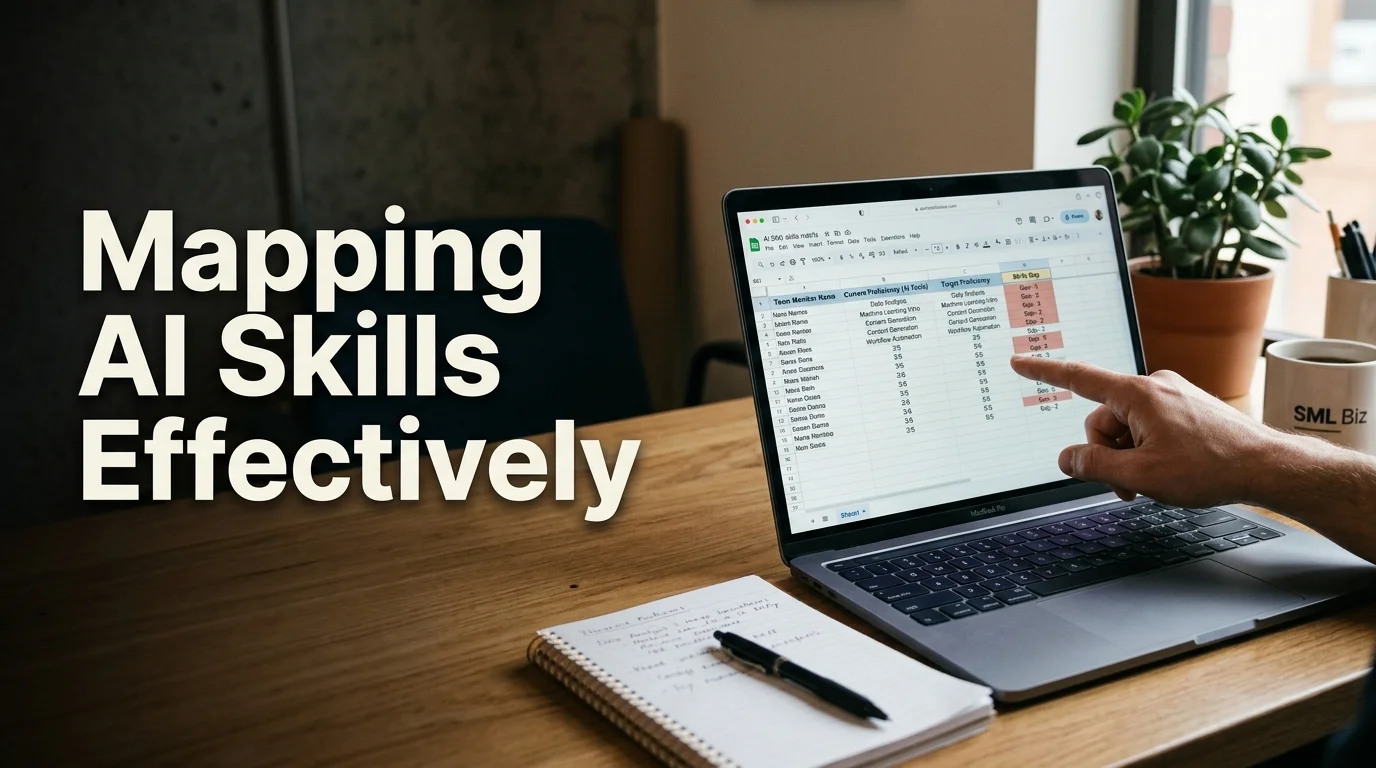
An AI skills matrix (some teams call it an AI capability matrix) shows who on your team can do what with AI, how well, and where training should go first. Here is how to build one for a small team.
Key takeaways
- An AI skills matrix maps each team member’s current proficiency, target proficiency, gap, and last assessment date across the AI skill areas their work needs.
- A four-level scale is enough: no experience, basic awareness, functional use, and confident independent use.
- Skill areas should reflect real work, such as prompting for written outputs, output review and editing, workflow integration, data summarization, prompt library maintenance, and AI policy and data handling.
- Set target levels by role before assessing anyone, then prioritize large gaps in high-impact skill areas.
- A simple spreadsheet works for teams of twenty or fewer. Update it when tools or roles change and reassess every six months, with one named owner.
Know who on your team can actually do what, before you design any training
A skills matrix is a structured map of capabilities across a team, so an AI capability matrix is the same document under another name. For AI, it answers the question: who can do what with these tools, how well, and for which tasks? Without this map, training decisions are based on assumption rather than evidence. Programs address gaps that do not exist and miss the ones that do.
The skills matrix is a planning tool. Keep it out of performance reviews, because team members who believe they are being evaluated will underreport their struggles, which produces a matrix that reflects desired performance rather than actual capability.
What a Small Business AI Skills Matrix Tracks
A useful AI skills matrix for a small business tracks four things for each team member, across each relevant AI skill area.
Current proficiency level. Where does this person currently stand? A simple four-level scale is sufficient: no experience, basic awareness, functional use, and confident independent use. More granular scales produce false precision and require more maintenance than they return in value.
Target proficiency level. Where does this role need to be? Not every role requires the same AI capability. A client services role and an operations role have different target proficiency levels for different skill areas. The matrix makes this explicit.
Gap. The distance between current and target. This is the training priority signal. Large gaps in high-frequency, high-impact skill areas are where training investment should concentrate.
Last assessed. When was this person’s proficiency in this area last evaluated? AI literacy requirements evolve as tools evolve. A proficiency assessment from a year ago may not reflect current capability or current requirements.
Defining the Skill Areas
The skill areas in the matrix should reflect the actual work the team does, not generic AI categories. A matrix organized around “prompting,” “AI tools,” and “data analysis” is too abstract to drive specific training decisions.
For a small business with operational, client-facing, and administrative roles, a more useful set of skill areas might include:
Prompting for written outputs. The ability to write effective prompts that produce high-quality drafts for communications, proposals, documentation, and reports. This is the most broadly applicable AI skill for most small business roles.
Output review and editing. The ability to evaluate AI-generated outputs quickly and accurately, identify errors and inconsistencies, and edit to the required standard with minimal iterations. This skill is often omitted from training programs and is a common source of quality problems in AI-assisted work.
Workflow integration. The ability to identify where AI can improve an existing workflow, adapt a process to incorporate AI steps, and use documented SOPs with AI tools embedded. This moves beyond individual tool use to operational application.
Data summarization and review. The ability to use AI to synthesize information from multiple sources, prepare meeting briefs, distill long documents into actionable summaries, and identify key points from data sets. This is high-value for operations, project management, and client-facing roles.
Prompt library maintenance. The ability to document effective prompts in a shared format, update the library when better approaches are found, and use the library as a starting point for new tasks. This is a team-level skill that supports organizational learning.
AI policy and data handling. Understanding which data categories can and cannot be used with AI systems, how to handle client information appropriately, and what the company’s AI use policy requires. This is compliance, not capability, but it needs to be assessed and maintained.
Building the Matrix
Building an AI team skill matrix starts with a simple grid: roles as rows and skill areas as columns. For each cell, record the current proficiency level, the target proficiency level, and the date of last assessment.
A simple spreadsheet works well for teams of twenty or fewer, and a free one is enough. Treat the grid as a template you can copy and adjust to your roles. Formatting matters only to the extent that it makes the matrix easy to read and update. Color coding by gap size, green for no gap, yellow for one-level gap, red for two-level gap, makes priority areas visible at a glance.
Step 1: Define target proficiency levels by role
Before assessing anyone, fill in the target proficiency column for each role. This requires thinking carefully about what AI capability each function actually needs to perform at the level you expect.
A client services role that handles initial outreach and follow-up communications needs confident independent use in prompting for written outputs and output review. A basic awareness of data summarization may be sufficient if that role rarely needs to synthesize large volumes of information.
An operations role that manages reporting, process documentation, and vendor coordination needs confident independent use across most skill areas, since AI has broad applications across those functions.
Writing these targets down before assessing anyone prevents the common error of calibrating expectations to current performance rather than actual operational requirements.
Here is an example of how the target column might look for two roles.
| Skill area | Client services target | Operations target |
|---|---|---|
| Prompting for written outputs | Confident independent use | Confident independent use |
| Output review and editing | Confident independent use | Confident independent use |
| Data summarization and review | Basic awareness may be sufficient | Confident independent use |
Step 2: Assess current proficiency
Assess current proficiency through a combination of self-report and direct observation. Self-report is a starting point. Observed performance is the more reliable signal.
For self-report, ask team members to rate their own proficiency in each skill area using the four-level scale. Include a brief description of what each level looks like in practice so ratings are calibrated consistently across the team.
For direct observation, ask each team member to complete one or two tasks in the skill areas where their self-reported proficiency is highest and where the gap is smallest. Compare the output quality to the target standard for that role. The gap between self-reported and observed proficiency tells you something important about both the team member’s self-awareness and your quality benchmarks.
Step 3: Calculate and prioritize gaps
With current and target proficiency recorded for each cell, the gaps are visible. Prioritize training investment based on two dimensions: gap size and skill area impact.
High-impact skill areas are those used frequently and tied to outputs with measurable business value. Large gaps in high-impact areas are the first priority. Large gaps in low-impact areas can wait.
Gaps that are consistent across multiple team members in the same role suggest a systemic training need that should be addressed through a structured program for that role. Gaps concentrated in one individual suggest a targeted individual development approach.
Using the Matrix to Drive Training Decisions
The matrix is a prioritization tool. Once it is built, every training decision should connect back to it.
When designing a training program, the matrix tells you which skill areas to cover, at what level, and for which roles. A training program built from the matrix is specific, relevant, and tied to actual operational requirements.
When evaluating a training vendor or program, the matrix tells you whether the proposed content addresses your actual gaps or someone else’s. Generic AI training programs are built around common gaps, not your specific ones.
When reviewing training outcomes, the matrix provides the before snapshot. Reassessing after training shows which gaps closed and which remain, making the ROI of the training investment visible and actionable.
Keeping the Matrix Current
A skills matrix that is not maintained becomes inaccurate and stops being used. Plan for two types of updates.
Event-driven updates. When the business deploys a new AI tool, introduces a new workflow, or changes the scope of a role, review the affected rows and columns immediately. New tools create new skill areas. Role changes create new target proficiency requirements.
Scheduled reassessments. Every six months, re-assess team member proficiency across all skill areas. As people use AI tools regularly, their proficiency increases without any formal training. As tools evolve, skills that were advanced become standard and new capabilities create new gaps. A semi-annual reassessment keeps the matrix calibrated to current reality.
Assign maintenance responsibility explicitly. The internal AI operations lead is the natural owner for the skills matrix. When no one owns it, it is updated once and then ignored.
What the Matrix Reveals Over Time
A skills matrix maintained over eighteen to twenty-four months becomes a longitudinal picture of how AI capability is developing across the team. This data supports several useful decisions.
It shows which team members are developing AI capability faster than others, making them candidates for the internal AI operations role or peer coaching responsibilities. It shows which skill areas have persistent gaps despite training investment, indicating either a training design problem or a structural barrier that training alone cannot address. And it shows how the team’s aggregate AI capability is growing, which is the most defensible evidence of return on training investment available to a small business founder.
The matrix is not the goal. The goal is a team that uses AI effectively as part of how work gets done. The matrix is the instrument that tells you where you are and what you need to do next.
Common questions
How do you start building an AI team skills matrix?
Open a spreadsheet, put roles down the side and AI skill areas across the top. Fill in the target level for each role first, then assess each person against it and record the date. Color the gaps green, yellow, and red so the priorities jump out.
What skill areas belong in an AI skills matrix?
The ones tied to the work your team actually does. For most small businesses that means prompting for written outputs, output review, workflow integration, data summarization, prompt library upkeep, and AI policy and data handling. Skip abstract categories like “AI tools” because they will not tell you what to train.
How is a skills matrix different from a performance review?
A skills matrix is a planning tool, not an evaluation. If people think they are being graded, they hide their struggles and the matrix shows what you hoped for instead of what is real. Tell the team that plainly before you ask them to rate themselves.
How often should the matrix be updated?
Whenever you add a tool, change a workflow, or change a role, plus a full reassessment every six months. Give it one owner. A matrix nobody owns gets filled in once and then forgotten.
What does the matrix tell you after a year or two?
It shows who is picking up AI fastest, which gaps persist despite training, and how the team’s overall capability is growing. That last one is the clearest evidence a founder has that training money was well spent.
Related reading: How to Run an AI Training Gap Analysis for Your Small Business Team | AI Team Adoption: Why Most Small Business Implementations Fail
Ready to assess where your team stands and build the capability they need? Explore AI training programs for small businesses.