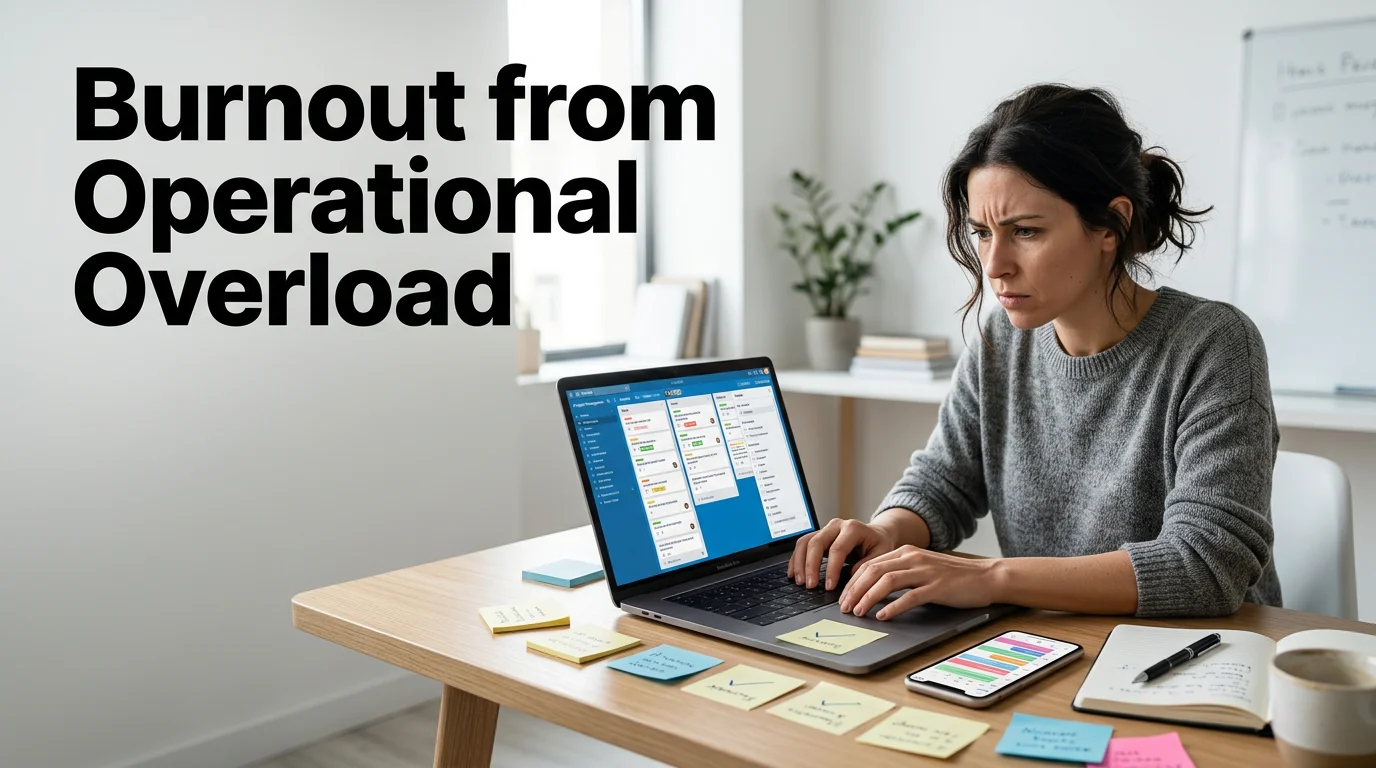
Burnout comes from a business structure that never scaled, not from a mindset problem.
The burnout conversation in founder circles tends to focus on mindset. Rest more. Set boundaries. Practice gratitude. Delegate better. Protect your calendar.
The advice is not wrong. But it addresses the symptom without diagnosing the cause.
For most founders who are burned out, the underlying cause is operational. The business is structured in a way that requires them to hold too much cognitive load, make too many routine decisions, and stay involved in too much work that the business has not been designed to handle without them.
This is a structural problem. Structural problems have structural solutions. Mindset work alone does not fix a broken system.
What Founder Burnout Actually Looks Like
Before treating burnout as a personal failing, it is worth examining the conditions that produce it.
A founder working in an operational system that has not scaled will find themselves:
- Holding the context for multiple projects simultaneously because it lives nowhere else
- Spending significant time on coordination work (status checks, follow-ups, approvals) that should not require their involvement
- Making dozens of small decisions per day that should be made by documented criteria or delegated to the team
- Firefighting recurring problems that keep coming back because the root cause has never been addressed
- Working hours that do not move the business forward because they are consumed by operations that return nothing
None of this is because the founder lacks discipline or boundaries. It is because the infrastructure of the business has not kept pace with its complexity. The cognitive load is real. The workload is real. The exhaustion is earned.
The question is whether the solution is personal or structural.
The Cognitive Load Problem
Operational systems that run on human memory and coordination are expensive to maintain cognitively.
When processes are not documented, someone has to remember them. When data is not in a system, someone has to know where it is. When decisions are not governed by clear criteria, every situation requires deliberate judgment rather than pattern-matching.
For founders, this overhead accumulates invisibly. It is not one large burden: it is hundreds of small ones. The cognitive cost of holding context across ten active clients, tracking the status of twenty open projects, remembering which team member needs which information, and monitoring which tasks are approaching their deadlines is enormous.
Well-designed operational systems redistribute this load from human memory to structured tools. The system holds the context. The system surfaces the status. The system tracks the deadlines. The human is freed to direct and decide rather than track and remember.
The difference in cognitive burden between running a well-systemized operation and a manual-coordination operation is substantial. And it shows up directly in how sustainable the work feels.
The Interruption Pattern
One of the most consistent signatures of operational burnout is the interruption pattern.
In a business without strong operational infrastructure, the founder is the answer to most questions. Where is that file? What is the status of that project? What should we do in this situation? How do we handle this client request? What is the process for this?
Every one of these questions is an interruption. Research on interruption and cognitive work consistently finds that recovering full concentration after an interruption takes fifteen to twenty minutes. In a business where interruptions are continuous (and for most founders running the ops coordination themselves, they are), deep focus work is structurally impossible.
Building the infrastructure that reduces these interruptions is a systems conversation, not a delegation conversation. An internal knowledge base reduces “where is that file?” A project management tool with live visibility reduces “what is the status?” Documented SOPs reduce “what is the process?” Decision criteria reduce “what should we do?”
These tools do not just give the team what they need. They give the founder their concentration back.
The Recurring Fire Problem
Burnout accelerates when the same problems keep coming back.
A client onboarding keeps going sideways for the same reason: a handoff step that was never defined. A report keeps being late because the data collection depends on manual effort that falls through the cracks. A team member keeps missing deadlines because there is no shared system for tracking what is due when.
Recurring fires are a signal that a process gap exists. Fixing the fire each time without addressing the gap means the same work is done over and over, consuming energy that should be going somewhere else.
The shift from firefighting to systems building is the single most important operational change a burned-out founder can make. Every recurring fire that gets replaced by a functioning process removes a future drain on attention and energy.
The Operational Bottlenecks That Kill Small Business Growth framework is a useful starting point for identifying which recurring fires are bottlenecks in disguise. If most of them trace back to you personally, start with the founder bottleneck diagnostic instead.
The Delegation Infrastructure Gap
“You just need to delegate more” is advice that sounds simple and lands badly for most founders.
The reason delegation is hard in most small businesses is a missing infrastructure for delegation, not a founder who cannot let go. Delegation without infrastructure looks like handing off a task, watching it not get done the way you expected, and then taking it back. That cycle repeats a few times and the conclusion becomes “I should just do it myself.”
What looks like a failure to delegate is actually a failure to build the systems that make delegation reliable.
Those systems include:
- Documented processes so the team member knows exactly what the steps are
- Clear success criteria so both parties agree on what done looks like
- Visibility so the founder can see progress without having to ask
- Escalation protocols so the team member knows when to bring something back
When these are in place, delegation becomes a reliable transfer of work to a system that can hold it.
The Structural Fix
For founders experiencing genuine operational burnout, the sustainable solution has three components:
Reduce cognitive load: Build the systems that hold the information your brain is currently tracking. Project management tools, documented SOPs, an operations dashboard. Stop being the memory of the business.
Reduce interruption overhead: Create the infrastructure that gives your team what they need without routing through you. Internal knowledge base, defined decision criteria, clear escalation paths. Stop being the answer to every question.
Eliminate recurring fires: Identify the processes that keep breaking and fix them structurally. One SOP written now eliminates dozens of fires in the future.
None of this requires hiring. It requires building.
For most founders in the $1M to $3M range, a focused six to eight week effort to address these three areas produces a material reduction in operational burden. The work does not disappear. But the work that remains is the work that requires you. The coordination overhead, the information retrieval, the recurring fires. All of it is solvable.
When to Ask for Help
Founders who have been in operational burnout for an extended period often cannot see the system clearly enough to fix it themselves. The same cognitive load that is causing the problem makes it hard to step back and diagnose it.
This is where an outside perspective is useful. An AI operations audit gives you a structured look at what is actually happening in your operation: where the load is concentrated, what is automatable, and what sequence of changes produces the fastest relief.
Treat it as a systems diagnosis. Mindset work comes later, if at all.
The problem is structural. The solution is too.
Related reading: The Hidden Cost of Operational Chaos · How Founders Can Run Operations Without an Ops Manager · AI Operations for Small Businesses: The Complete Guide