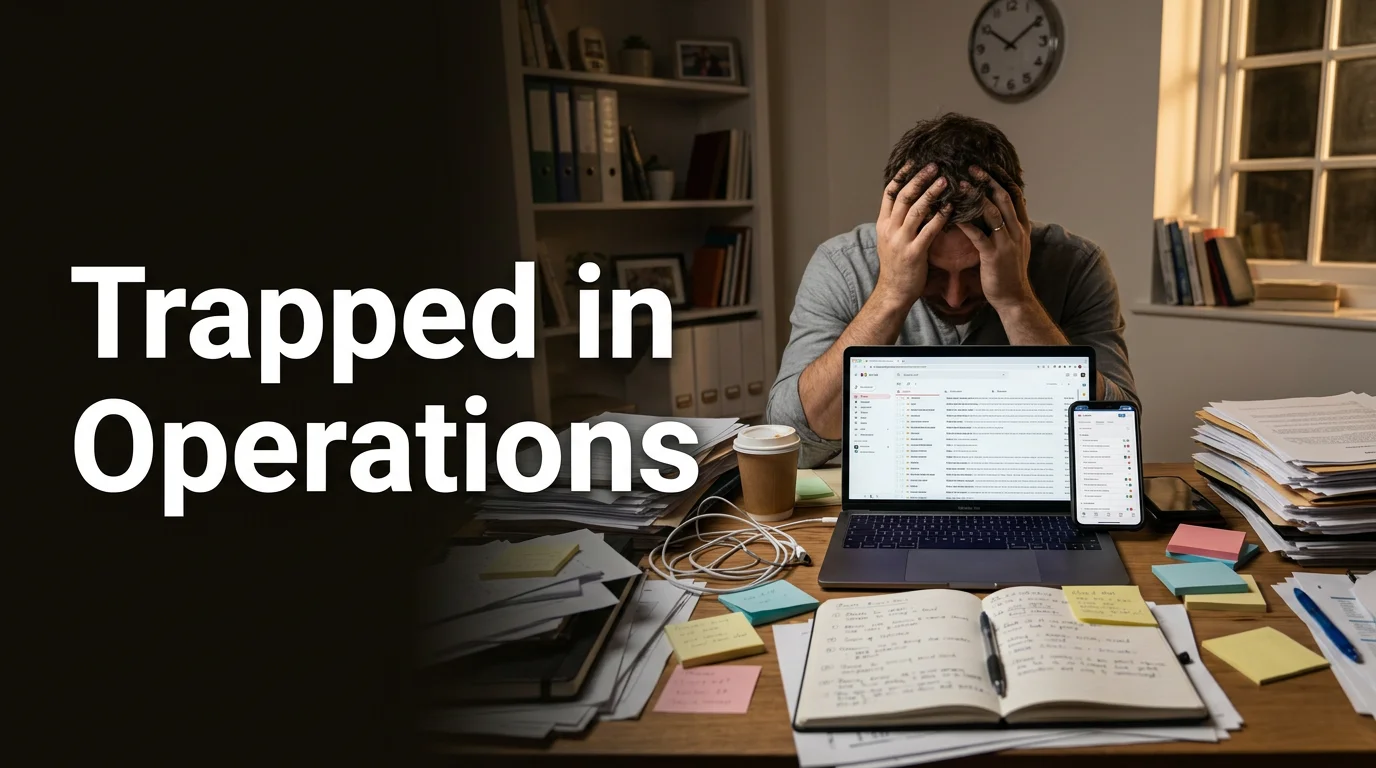
Nobody Designs This Trap: It Emerges the Moment You Stop Building Systems
Most founders did not set out to run operations. They set out to build a product, deliver a service, develop a skill, or solve a problem they understood deeply. Operations was supposed to be the background function that kept everything running while they focused on the work that actually mattered.
Somewhere along the way, that arrangement reversed itself. Operations became the thing they spent most of their time on. The real work, the client relationships, the strategy, the decisions with the biggest payoff, started happening in the margins, if it happened at all.
This is the founder ops trap: the point where the founder becomes the default operations system for the whole business. Nobody chooses it. It is a structural outcome that happens to nearly every founder who builds past the initial stage without deliberately designing around it.
How the Trap Forms
In the early days, founder-as-operator makes sense. The team is small. The volume is manageable. The founder has all the context. Routing questions, decisions, and coordination through them is simply the path of least resistance.
The problem is that this arrangement calcifies. As the business grows, new team members are onboarded into the same pattern. They learn quickly that when something is unclear, the answer is to ask the founder. When a decision needs to be made, it goes up. When a process does not exist, the workaround is to escalate.
No one designs this deliberately. It emerges from the absence of design. The founder is the de facto operations system because nothing else was built to replace them.
By the time the trap is clearly visible, it has been in place for a long time and is deeply embedded in how the whole team works.
What the Trap Actually Costs
The visible cost is time. Founders in the trap spend a significant portion of each week answering questions that should have documented answers, making decisions that should have clear owners, and managing coordination that should happen through a system rather than through them personally.
The less visible costs are more significant.
Decision quality degrades. When the founder is the decision point for too many things, each individual decision gets less attention. Important strategic choices compete for the same cognitive bandwidth as routine operational questions. The result is that major decisions get made in the same distracted, reactive state as minor ones.
The team does not develop. When every unclear situation routes to the founder, team members never build the judgment to handle those situations independently. The team stays dependent not because they are incapable but because the system does not require them to develop capability. The founder becomes a ceiling on the team’s growth as well as their own.
Clients and partners experience instability. A business where everything flows through the founder has a single point of failure. When the founder is unavailable, sick, traveling, or simply overloaded, things stop. Clients notice. Deadlines slip. Quality becomes inconsistent.
Growth becomes self-limiting. Taking on bigger clients, expanding into new markets, or adding new service lines requires founder capacity. If the current book of business is already consuming all available founder time, growth is structurally impossible without something changing.
The Misdiagnosis
Founders in the trap often misdiagnose their situation. The experience feels like a workload problem, so the response is to work longer hours or hire someone to help carry the load. Neither addresses the underlying structure.
Working longer solves nothing. The trap is a steady state, not a temporary peak, and it will persist and expand as the business grows, because the system that creates it does not change when the hours change.
Hiring helps in some cases, but only if what gets hired is a system, not just another person. Bringing on an operations manager or a project coordinator can be valuable, but only if their role is defined, their authority is real, and there is an actual process for them to own and improve. Hiring someone to absorb the founder’s overflow without changing the underlying routing of decisions and coordination just creates a middle layer that the founder eventually works around.
What the Exit Actually Requires
Getting out of the founder ops trap is a structural problem that requires a structural solution.
The first step is documentation. The answers that currently live only in the founder’s head need to be externalized. Standard operating procedures for recurring work, decision frameworks for common judgment calls, clear definitions of who owns what and what good output looks like. This work feels slow and unglamorous. It is also the only thing that makes sustainable delegation possible.
The second step is routing. Once the answers exist outside the founder’s head, the team needs to be retrained to go to those sources first rather than escalating by default. This requires reinforcement. The first several times a team member asks a question that has a documented answer, pointing them to the documentation rather than just answering is more valuable in the long run than the few seconds it takes to respond directly.
The third step is automation. Many of the things that route to the founder turn out to be information retrieval, status checks, coordination tasks, and routine approvals that follow predictable patterns. AI tools and workflow automation can handle a significant portion of these entirely. Intake systems that collect and route requests automatically, dashboards that give the team visibility into project status without asking, automated responses to common client questions, these remove the need for founder involvement at the coordination layer entirely.
The Business That Does Not Depend on You
The goal is to take the founder out of the operations infrastructure, not out of the business, so their time and attention can go to the work that requires them: client relationships, strategic decisions, business development, and the areas where their expertise creates the most value.
A business designed this way is more resilient, easier to grow, and worth more. The team functions independently on routine work. The founder is available for the decisions that actually matter. Clients experience consistency rather than variability. Growth does not require the founder to personally absorb every additional hour.
Building that business starts with recognizing the trap for what it is, not a workload problem or a team problem, but a systems problem, and deciding to solve it at that level.
Related reading: AI Operations for Small Businesses · Founder Burnout and the Operations Problem
Ready to build operations that do not run through you? Start with the free process audit.