
Depending on which survey you read, somewhere between about 20% and 82% of US small businesses use AI. Both numbers are real. They measure different things.
This page collects 126 statistics on small business AI from 23 publishers, including the Census Bureau, the Federal Reserve, the US Chamber of Commerce, Intuit and Goldman Sachs. Every number links to the page that published it, and every one was checked against that page in October 2026.
Key Takeaways
- 19.8% of US businesses of all sizes used AI in a business function in the two weeks before the Census Bureau’s May 2026 survey. This is the strictest measure on the page: a nationally representative panel asking about recent use, not about ever trying a tool (US Census Bureau, May 2026).
- 77% of US small and midsize businesses reported using AI regularly by January 2026, up from 48% in mid-2024. Intuit counts free tools and AI features built into software owners already pay for, which pulls the number up (Intuit QuickBooks, May 2026).
- Just 43% of US businesses with two to nine employees used AI for work tasks in May 2026. This is the bracket most founder-led service firms fall into (US Chamber of Commerce Foundation, June 2026).
- Only 14% of small businesses in the Goldman Sachs 10,000 Small Businesses network said AI was fully embedded in their core operations in 2026. Even in a network where 76% use AI, few have built it into how the business runs (Goldman Sachs 10,000 Small Businesses, March 2026).
- Just 6% of US small business workers who use AI used it to automate workflows with minimal human involvement in May 2026. Almost all AI use at small firms is a person working faster, not a process running on its own (US Chamber of Commerce Foundation, June 2026).
- 78% of US businesses using AI said it improved their productivity in January 2026, up from 46% in July 2024. The share seeing a productivity effect rose as owners gained experience with the tools (Intuit QuickBooks, May 2026).
- Privacy and security concerns were the most cited barrier to AI adoption, named by 36% of US businesses in January 2026. Intuit found the same top barrier in every country it tracked (Intuit QuickBooks, May 2026).
- Just 36% of US small and mid-market business owners had written policies governing employee AI use in 2026. Nearly two-thirds have no written rules (Nationwide, September 2026).
Why small business AI statistics disagree
Small business AI adoption figures run from about 20% to over 80% because each survey defines both “small business” and “uses AI” differently. The Census Bureau asks every kind of business about recent use in a business function. Private surveys ask owners whether they use any AI tool at all, often within a network of engaged owners.
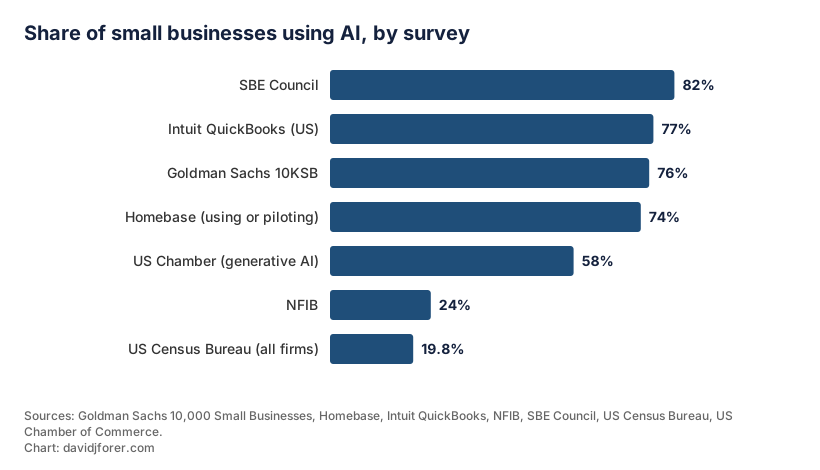
| Survey | Headline figure | What counts as “using AI” | Who was asked |
|---|---|---|---|
| US Census Bureau BTOS | 19.8% | Used AI in a business function in the last two weeks | All US businesses, any size |
| NFIB | 24% | Uses named AI tools for the business | NFIB members |
| US Chamber of Commerce | 58% | Uses generative AI | Firms under 250 employees |
| Homebase | 74% | Using or piloting AI tools | Firms with 5 to 499 staff and hourly teams |
| Goldman Sachs 10KSB | 76% | Currently using AI | Program participants |
| Intuit QuickBooks | 77% | Uses AI regularly, including free and built-in tools | US small and midsize businesses |
| SBE Council | 82% | Uses at least one AI tool | Firms with 2 to 99 employees |
The strict measures
- 19.8% of US businesses of all sizes used AI in a business function in the two weeks before the Census Bureau’s May 2026 survey. This is the strictest measure on the page: a nationally representative panel asking about recent use, not about ever trying a tool (US Census Bureau, May 2026).
- Nearly a quarter (24%) of NFIB member small business owners used AI technologies in their business in 2025. NFIB asked about named tools and polls its own members, many of them very small or without employees, which helps explain the low figure (NFIB, June 2025).
- 39% of US small and midsize businesses used AI in 2024, up from 14% in 2023. Verizon’s 2025 edition found 38% actively integrating AI into operations, which suggests adoption flattened after the first jump (Verizon Business, October 2024).
The broad measures
- 58% of US small businesses said they use generative AI in 2025, up from 40% in 2024. The US Chamber defines small as under 250 employees, so firms far larger than a 10-person shop sit inside this figure (US Chamber of Commerce, August 2025).
- 74% of US small business owners and managers were using or piloting AI tools in 2026. Piloting is a low bar, and the sample is firms with 5 to 499 staff and hourly teams (Homebase, September 2026).
- 76% of small businesses in the Goldman Sachs 10,000 Small Businesses network reported using AI in early 2026. The sample is program participants who chose a growth education program, so it likely runs ahead of the average firm (Goldman Sachs 10,000 Small Businesses, March 2026).
- 77% of US small and midsize businesses reported using AI regularly by January 2026, up from 48% in mid-2024. Intuit counts free tools and AI features built into software owners already pay for, which pulls the number up (Intuit QuickBooks, May 2026).
- 82% of US small businesses with 2 to 99 employees used at least one AI tool in February 2026. One tool of any kind counts, including AI features inside software the business already uses (SBE Council, March 2026).
- Only 20% of owners in Small Business Majority’s network were using no AI tools at all in September 2026. The network leans toward women- and minority-owned firms with fewer than 10 staff, and the sample is 222 owners (Small Business Majority, September 2026).
Counting workers instead of businesses
- Half of all workers at US small businesses used AI at work in May 2026. This counts people, not companies, so one employee using a chatbot on their own counts even if the business has no AI plan (US Chamber of Commerce Foundation, June 2026).
- 75% of small and midsize businesses worldwide were at least experimenting with AI in late 2024. This Salesforce figure is global, not US-only, and experimenting is the loosest definition in the set (Salesforce, December 2024).
How many small businesses use AI in 2026
Most surveys of owners now find a majority using some form of AI, while the Census Bureau’s stricter question puts all US businesses near one in five. Growth continues, but the official data shows a steady climb rather than a jump.
The official count
- Between 20% and 23% of US businesses expected to be using AI within six months, according to Census data from December 2025 to May 2026. Expected use runs only a few points ahead of current use, so the official measure shows steady growth rather than a surge (US Census Bureau, May 2026).
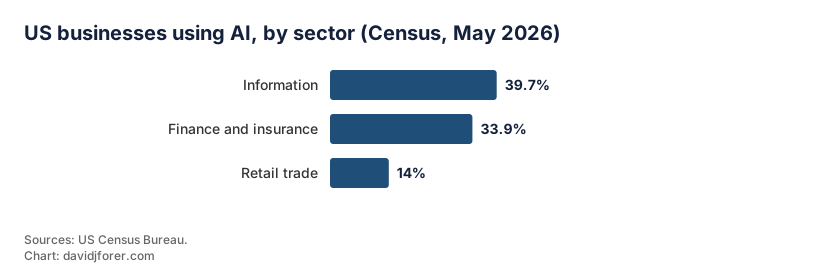
- 39.7% of US businesses in the Information sector used AI as of May 2026, about double the 19.8% national rate. Sectors built on writing and analysis adopt first (US Census Bureau, May 2026).
- 33.9% of US Finance and Insurance businesses used AI as of May 2026. Finance sits second only to the Information sector in the Census data (US Census Bureau, May 2026).
- Around 14% of US retail businesses used AI in spring 2026, and about 17% expected to within six months. Retail runs below the national rate, which matters for owners comparing themselves with headline figures (US Census Bureau, May 2026).
Year-over-year change
- 64% of US small business owners and managers were using or piloting AI in 2025, the year before Homebase’s 74% reading. That 10-point rise in one year came from the same survey design (Homebase, September 2026).
- 69% of small businesses in Small Business Majority’s network used some kind of AI technology, according to research published in August 2024. By September 2026 the share of that network using no AI at all had fallen to 20% (Small Business Majority, August 2024).
- Half of small businesses under $100,000 in revenue used AI in Small Business Majority’s 2024 research, against 8 in 10 (78%) above that level. The revenue gap shows up again in the 2026 data below (Small Business Majority, August 2024).
Who is next
- 62% of US small businesses not yet using AI said they were still interested in 2026. Most holdouts have not ruled AI out. They are waiting for a reason to start (Homebase, September 2026).
- Fourteen percent of NFIB small businesses not using AI in 2025 planned to use an AI product soon. Among NFIB’s mostly very small members, interest among non-users stays modest (NFIB, June 2025).
- 62% of US small businesses using AI expected to increase their AI spending over the next year, and only 3% expected to cut it. Spending intent among current users points one way (SBE Council, March 2026).
- 78% of growing small and midsize businesses planned to increase AI investment, against 55% of declining ones, in a global 2024 Salesforce survey. Firms that are already growing spend more on AI, which makes AI results hard to separate from momentum (Salesforce, December 2024).
- 58% of small business workers who use AI used it on a more regular basis in May 2026. The rest use it occasionally, so worker adoption figures overstate daily use (US Chamber of Commerce Foundation, June 2026).
The firm size gap in AI adoption
The smaller the business, the less likely it uses AI. That holds in Census data, in the US Chamber Foundation’s worker survey, in Homebase’s owner survey and across OECD countries. A business with 5 to 20 staff sits near the bottom of every one of these curves.
By number of employees
- Less than 20% of US firms with four or fewer employees reported using AI between December 2025 and May 2026. The smallest firms are where the official data shows the least movement (US Census Bureau, May 2026).
- Just 43% of US businesses with two to nine employees used AI for work tasks in May 2026. This is the bracket most founder-led service firms fall into (US Chamber of Commerce Foundation, June 2026).
- 59% of US businesses with 100 to 249 employees used AI for work tasks in May 2026. The gap to the smallest firms is 16 points in the same survey (US Chamber of Commerce Foundation, June 2026).
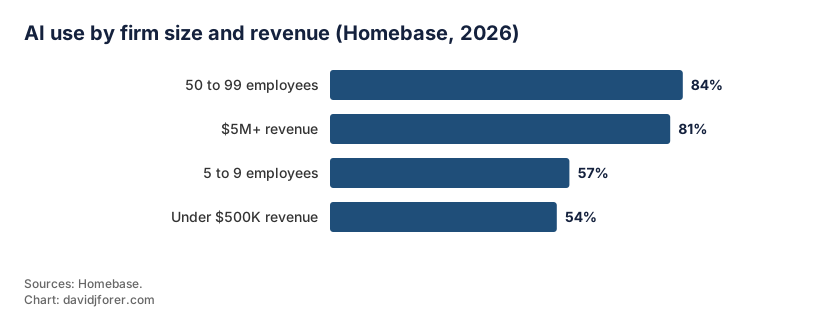
- 57% of US businesses with 5 to 9 employees were using or piloting AI in 2026. That is the lowest size band in Homebase’s survey (Homebase, September 2026).
- 84% of US businesses with 50 to 99 employees were using or piloting AI in 2026. A 27-point gap separates them from firms with 5 to 9 staff (Homebase, September 2026).
- 32% of US firms with 100 to 249 employees used AI in May 2026. Adoption drops with each step down in firm size (US Census Bureau, May 2026).
- 37% of US firms with 250 or more employees used AI in their operations in May 2026. That is nearly double the all-business rate (US Census Bureau, May 2026).
By revenue
- Just 54% of US small businesses under $500K in annual revenue were using AI in 2026. Cash and time to experiment are both thinner at this size (Homebase, September 2026).
- 81% of US small businesses with $5M or more in revenue were using AI in 2026, a 27-point gap over firms under $500K. The more a business earns, the more likely it is already using AI (Homebase, September 2026).
Outside the US
- Only 11.9% of firms with 10 to 49 employees across OECD countries used AI in 2024. The smallest firms the OECD measures adopt at less than a third of the large-firm rate (OECD, December 2025).
- 20.4% of firms with 50 to 249 employees across OECD countries used AI in 2024. Mid-sized firms adopt at about half the rate of large ones in the OECD data (OECD, December 2025).
- 40% of firms with 250 or more employees across OECD countries used AI in 2024. The OECD measures firms with at least 10 employees, so its figures cover a different population than US surveys (OECD, December 2025).
Using AI is not the same as running on it
Most small businesses that use AI use it as a personal assistant for one person at a time. Few have built it into the processes that run the business, and fewer still pay for dedicated AI tools.
How deep the use goes
- Only 14% of small businesses in the Goldman Sachs 10,000 Small Businesses network said AI was fully embedded in their core operations in 2026. Even in a network where 76% use AI, few have built it into how the business runs (Goldman Sachs 10,000 Small Businesses, March 2026).
- Just 9% of small and midsize businesses had fully embedded AI into strategy, operations and decision-making in late 2025. That global figure sits close to the 14% Goldman Sachs found among US small businesses (SAS and IDC, May 2026).
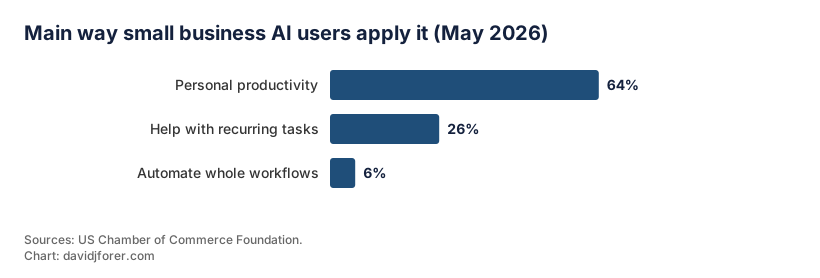
- Just 6% of US small business workers who use AI used it to automate workflows with minimal human involvement in May 2026. Almost all AI use at small firms is a person working faster, not a process running on its own (US Chamber of Commerce Foundation, June 2026).
- 64% of US small business workers who use AI said their primary application was personal productivity, such as drafting, summarizing and brainstorming. The gain stays with the person, and the business process does not change (US Chamber of Commerce Foundation, June 2026).
- 37% of small and midsize businesses were still experimenting with AI in isolated ways in late 2025. Experiments in one team rarely change how the whole business runs (SAS and IDC, May 2026).
Paying for it
- 12% of US businesses with QuickBooks payment records paid for dedicated AI tools between 2021 and 2025. Payment data shows a far smaller committed core than the 77% who say they use AI regularly (Intuit QuickBooks, September 2026).
What holds the depth back
- 44.8% of small and midsize businesses had no structured view of their AI use cases in late 2025. The SAS and IDC sample covers firms of 100 to 999 staff worldwide (SAS and IDC, May 2026).
- 44.7% of small and midsize businesses said their data was scattered across tools with no clear ownership or definitions. AI tools can only work with data they can reach and trust (SAS and IDC, May 2026).
Core work, internationally
- AI use in core business functions reached 6.1% of US firms in 2024, the highest of the countries the OECD compared. Using AI to make the product or deliver the service is still rare, even in the US (OECD, December 2025).
- Among SMEs using generative AI in Canada, Germany, Japan and the UK, only 29% used it in their core activities in 2024. Light use outside core work is the pattern across countries (OECD, December 2025).
What small businesses use AI for
Writing, research and marketing lead every survey of small business AI use. These are tasks where a person can check the output before it reaches a customer. Recurring operational work, where time savings add up week after week, comes much later.
By task
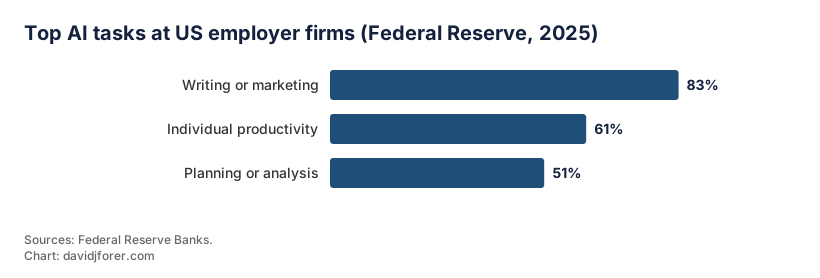
- 83% of US employer firms using AI applied it to writing or marketing, the most common task in the Federal Reserve’s 2025 survey. The survey covered 6,525 employer firms with 1 to 499 staff (Federal Reserve Banks, March 2026).
- 61% of US employer firms using AI applied it to individual productivity in 2025. Personal productivity ranks second in the Fed data, matching what workers report (Federal Reserve Banks, March 2026).
- 51% of US employer firms using AI applied it to planning or analysis in 2025. Planning is the first use that moves from one person’s work to the business (Federal Reserve Banks, March 2026).
- 90% of AI-using workers at US small businesses who write and edit communications used AI for that task in May 2026. Writing is the most common entry point (US Chamber of Commerce Foundation, June 2026).
- 88% of AI-using small business workers who do research used AI for research and information gathering. Research and writing lead because the output is easy to check before it goes anywhere (US Chamber of Commerce Foundation, June 2026).
- 26% of US small business workers who use AI said their primary use was help with recurring tasks. Recurring tasks are where time savings compound, yet only about a quarter start there (US Chamber of Commerce Foundation, June 2026).
By tool
- 44% of US small businesses used generative AI chatbots in 2025. Chatbots were the most common AI tool type in the US Chamber survey (US Chamber of Commerce, August 2025).
- 20% of US small businesses used AI coding tools to write or check code in 2025, according to the US Chamber. Coding help has spread well beyond software firms (US Chamber of Commerce, August 2025).
- 16% of US small businesses used AI image creation tools in 2025. Image tools trail chatbots by a wide margin (US Chamber of Commerce, August 2025).
Marketing and customer work
- More than a quarter (28%) of US small and midsize businesses used AI for marketing and social media in 2025. Marketing led the use cases Verizon reported (Verizon Business, May 2025).
- 24% of US small and midsize businesses used AI for written communications in 2025. Email and customer messages are a common second use (Verizon Business, May 2025).
- AI adoption in US small business marketing rose from 26% in 2023 to 87% by April 2026, according to Constant Contact. Constant Contact sells AI marketing tools, which is worth knowing when reading this figure (Constant Contact, June 2026).
- 38% of US small and midsize businesses were actively integrating AI into their operations in 2025. That is almost unchanged from the 39% using AI a year earlier in Verizon’s survey (Verizon Business, May 2025).
Analysis and content
- 62% of US small businesses using AI applied it to data analysis in 2025. Thryv sells small business software, and analysis led content generation in its survey (Thryv, July 2025).
- 55% of US small businesses using AI used it for content generation in 2025. Content generation ranked second in the same survey (Thryv, July 2025).
- 46% of US small businesses using AI used customer engagement tools like chatbots in 2025. Customer-facing AI sits close behind internal uses (Thryv, July 2025).
What results small business owners report from AI
Owners who use AI mostly report productivity gains. Fewer report revenue gains, cost savings or a shorter workday. Every figure in this section is self-reported by owners, not measured from their books.
Productivity
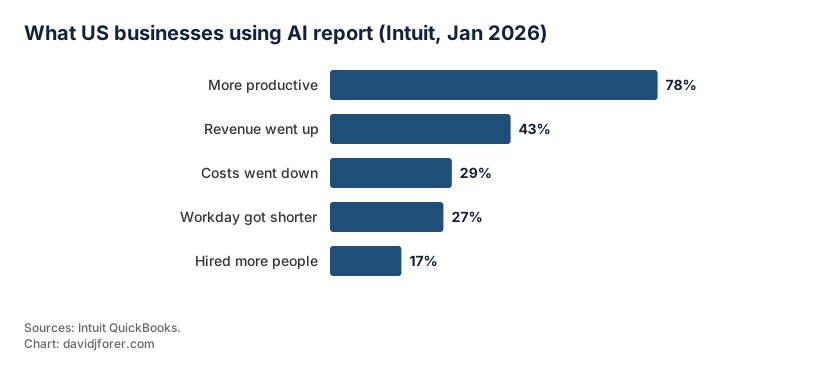
- 78% of US businesses using AI said it improved their productivity in January 2026, up from 46% in July 2024. The share seeing a productivity effect rose as owners gained experience with the tools (Intuit QuickBooks, May 2026).
- 71% of US employer firms using AI said it increased productivity, in the Federal Reserve’s 2025 survey. Productivity is the result owners report most often across the surveys on this page (Federal Reserve Banks, March 2026).
- 84% of those small businesses cited increased efficiency and productivity as the primary benefit of AI. Efficiency, not revenue, is what owners notice first (Goldman Sachs 10,000 Small Businesses, March 2026).
- 87% of US small businesses agreed that AI has increased efficiency, will provide economic growth and helps them enjoy running their business. The question bundles several benefits, so read it as general approval (US Chamber of Commerce, August 2025).
- 93% of Goldman Sachs 10,000 Small Businesses participants using AI said it had a positive impact on their business in 2026. This is self-reported by owners in a growth-focused network (Goldman Sachs 10,000 Small Businesses, March 2026).
Revenue and cost
- 43% of US businesses using AI reported an increase in revenue driven by AI in January 2026, and only 2% reported a decrease. Reported gains outnumber losses by more than 20 to 1 (Intuit QuickBooks, May 2026).
- 22% of US small businesses using AI reported revenue gains of more than 10% attributed to AI in early 2026. Two-thirds of users reported some AI-linked revenue gain in the same SBE Council survey (SBE Council, March 2026).
- 31% of US employer firms using AI reported higher sales from it. Fewer firms see AI in revenue than in time saved (Federal Reserve Banks, March 2026).
- 29% of US businesses reported that AI reduced their costs in January 2026. Cost savings show up for fewer firms than productivity gains (Intuit QuickBooks, May 2026).
- 67% of Goldman Sachs 10,000 Small Businesses participants expected AI to increase revenue. Expectation runs ahead of the 43% reporting AI-driven revenue gains in Intuit’s separate survey (Goldman Sachs 10,000 Small Businesses, March 2026).
- 39% of US employer firms using AI said it improved the quality of their goods and services. Quality gains trail productivity gains by a wide margin (Federal Reserve Banks, March 2026).
Time
- 27% of US businesses using AI said it shortened their workday in January 2026, while 8% said it got longer. For most owners AI has not yet given hours back (Intuit QuickBooks, May 2026).
Jobs
- 17% of US businesses said AI increased employment at their business in January 2026, against 4% who said it led to cuts. AI is adding roles at small firms more often than removing them (Intuit QuickBooks, May 2026).
- AI-related employment decreases occurred in only 2% of US firms using AI, according to a Census Bureau study of more than 117,000 firms covering November 2025 to January 2026. The same study found most users (66%) rely on AI only to augment tasks (US Census Bureau, April 2026).
- 82% of US small businesses using AI increased their workforce over the past year, according to the US Chamber in 2025. Hiring and AI adoption rose together in this data, which does not show that AI caused the hiring (US Chamber of Commerce, August 2025).
- Eighty-seven percent of those business owners said AI augments rather than replaces employees. Owners at this size mostly see AI as help for the team they already have (Goldman Sachs 10,000 Small Businesses, March 2026).
Global comparisons
- 87% of small and midsize businesses with AI said it helped them scale operations, in a global 2024 Salesforce survey. The same survey found 86% saw improved margins (Salesforce, December 2024).
- 91% of small and midsize businesses with AI said it boosts their revenue, in a global 2024 Salesforce survey. Salesforce sells AI products to this market, and the sample spans four regions (Salesforce, January 2025).
Time and cost: the admin load AI is aimed at
Small business owners spend a large share of their week on admin, and AI spending at this size is modest. The clearest returns show up in routine work such as scheduling, payroll and getting paid.
Where the owner’s time goes
- More than a third (36%) of the average entrepreneur’s work week went to administrative tasks in a 2023 survey of 251 US founders. This is the admin load most small business AI tools are aimed at (Time etc, November 2023).
- The average work week for entrepreneurs running growing US businesses was 45.5 hours in the same 2023 survey. At 36%, admin takes about 16 hours of that week (Time etc, November 2023).
- Operational inefficiencies consumed 6.6 hours of US small business leaders’ time each week in 2025. That is close to a full working day lost to friction inside the business (business.com, June 2025).
- US small business leaders lost nearly a full workday (nine hours weekly) to multitasking and context switching in 2025. Switching costs fall hardest on owners who are the default answer to every question (business.com, June 2025).
- US small business owners lost an average of 96 minutes of productivity a day in 2024, according to a survey for Slack. Slack sells workplace messaging, and the survey covered firms of up to 2,000 employees (Slack, August 2024).
Getting paid
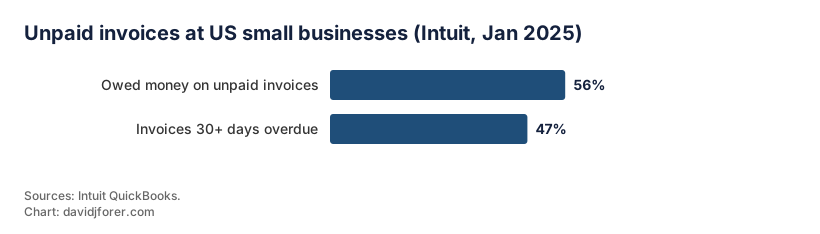
- Over half (56%) of US small businesses were owed money from unpaid invoices in January 2025. Chasing payment is one of the clearest admin jobs to automate (Intuit QuickBooks, May 2025).
- 47% of US small businesses had a portion of their invoices overdue by more than 30 days in January 2025. Late invoices tie up cash a small business cannot easily replace (Intuit QuickBooks, May 2025).
- US small businesses owed money on unpaid invoices were owed $17.5K on average. That is cash sitting outside the business after the work is already done (Intuit QuickBooks, May 2025).
What AI saves and costs
- US owners using AI for both scheduling and payroll saved an estimated 7.7 hours a month in 2026. That is about two hours a week from two admin tasks alone (Homebase, September 2026).
- The same owners saved an estimated $343 a month on scheduling and payroll. Homebase sells scheduling and payroll software, which is worth knowing when reading this figure (Homebase, September 2026).
- 46% of US small business decision-makers estimated manual payroll and scheduling errors cost them $500 or more a month. Errors in routine admin are a cost most owners never see on a report (Homebase, September 2026).
- The median US small business spent $2,200 a year on AI in early 2026. That works out to under $200 a month (SBE Council, March 2026).
Barriers to AI adoption in small businesses
Trust and know-how hold small businesses back more than price does. Privacy, accuracy and not knowing what AI could do for this specific business top every barrier list on this page. Cost comes later.
Trust, privacy and accuracy
- Privacy and security concerns were the most cited barrier to AI adoption, named by 36% of US businesses in January 2026. Intuit found the same top barrier in every country it tracked (Intuit QuickBooks, May 2026).
- Data privacy and security concerns remained the top reason US small businesses gave for not adopting AI, cited by 38% of non-adopters in 2026. The top concern did not change from the year before (Homebase, September 2026).
- Nearly half (47%) of US small business workers cited privacy or security concerns as a barrier to AI in May 2026. Staff share the same worry owners do (US Chamber of Commerce Foundation, June 2026).
- 26% of businesses cited concerns about AI accuracy, bias or errors as a barrier, across all four markets Intuit tracked. Owners worry about mistakes reaching customers (Intuit QuickBooks, May 2026).
- 31% of US small business non-adopters cited fear of mistakes as a reason not to use AI, and 27% said they simply do not trust it. Trust, not price, holds back most holdouts (Homebase, September 2026).
- 30 percent of non-adopters said they do not know how to keep sensitive data safe when using AI. Data safety is a skills gap as much as a policy gap (ICIC, February 2025).
Knowledge and skills
- 28% of US businesses cited lack of knowledge about AI’s capabilities as a barrier. Not knowing what AI could do for this specific business is the second biggest block (Intuit QuickBooks, May 2026).
- About 72 percent of US small business owners not using AI said a lack of knowledge of new digital tools kept them from adopting. ICIC’s survey of 3,752 owners points to the same knowledge gap as the other sources here (ICIC, February 2025).
- Forty-one percent of US small business workers said it was unclear how AI applies to their specific business. People cannot adopt what they cannot picture in their own job (US Chamber of Commerce Foundation, June 2026).
- 45% of small business owners using AI cited a lack of technical expertise as a barrier in late 2025. Even adopters hit a skills wall (Goldman Sachs 10,000 Small Businesses, October 2025).
- 47% of small business owners using AI said it was difficult to choose the right tools. Tool choice is now as big a barrier as skills (Goldman Sachs 10,000 Small Businesses, October 2025).
- 34 percent of US small business owners not using AI said AI tools are not useful for their business. For a third of holdouts the issue is relevance, not fear (ICIC, February 2025).
When owners must pick one
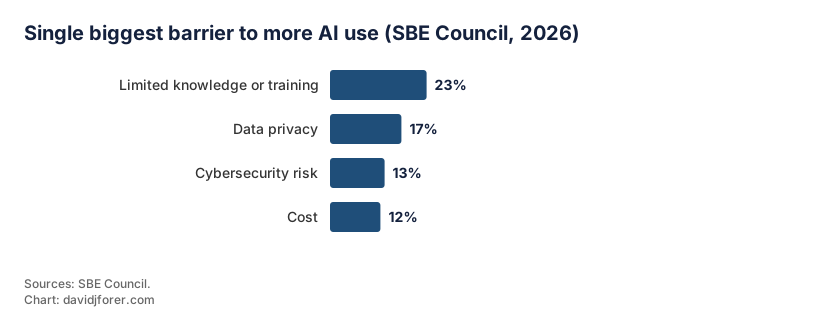
- 23% of US small businesses named limited knowledge or training as the single biggest barrier to further AI adoption in early 2026. Knowledge ranks first when owners must pick one barrier (SBE Council, March 2026).
- 17% of US small businesses named data privacy as their single biggest AI barrier. Privacy ranks second when owners must choose one (SBE Council, March 2026).
- 13% named cybersecurity risk as their single biggest AI barrier. Together, privacy and security outrank knowledge as a combined worry (SBE Council, March 2026).
- 12% of US small businesses said cost was the primary constraint on further AI adoption. Cost ranks below knowledge, privacy and security (SBE Council, March 2026).
Appetite for help
- 73% of Goldman Sachs 10,000 Small Businesses participants said more training and resources would help them implement AI. The gap is know-how, not interest (Goldman Sachs 10,000 Small Businesses, March 2026).
- 88% of those owners wanted more training and support to implement AI successfully. Demand for practical help is close to universal in this network (Goldman Sachs 10,000 Small Businesses, October 2025).
AI governance and staff-led adoption
In most small businesses, staff started using AI before the business wrote any rules for it. Written policies, training and checks on AI output are the exception at this size, and owners know it.
Policies and rules
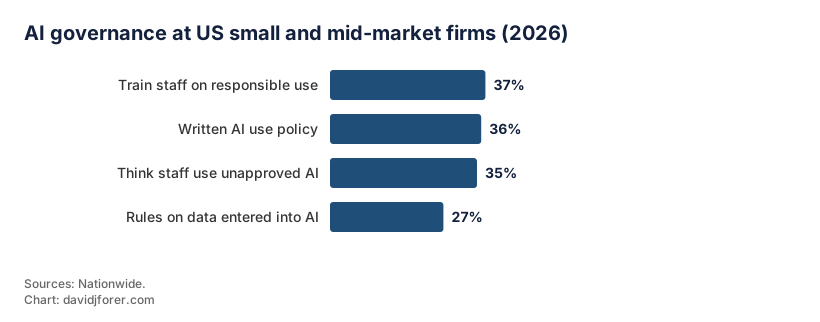
- Just 36% of US small and mid-market business owners had written policies governing employee AI use in 2026. Nearly two-thirds have no written rules (Nationwide, September 2026).
- Only 27% of US business owners said their businesses had rules on what company or customer information can be entered into AI tools. Client data is the risk most owners have not addressed (Nationwide, September 2026).
- More than a third (35%) of US small and mid-market business owners believed employees were using unauthorized AI tools for work in 2026. Owners already suspect the problem their policies do not cover (Nationwide, September 2026).
- 37% of US small and mid-market businesses provided training on responsible AI use. Training lags use in every survey on this page (Nationwide, September 2026).
Staff-led adoption
- About one in five workers at US small businesses (19%) said AI adoption at their organization was driven mostly by employees exploring tools on their own in May 2026. In many small firms, AI arrives from the bottom up before any policy exists (US Chamber of Commerce Foundation, June 2026).
- About one in 10 US small business workers said they were offered formal AI training in May 2026. Staff are using AI with little guidance from their employer (US Chamber of Commerce Foundation, June 2026).
- 80% of small and medium business employees who use AI brought their own AI tools to work, in Microsoft and LinkedIn’s 2024 global survey. Most staff AI use starts outside anything the company chose (Microsoft and LinkedIn, June 2024).
- 49% of small and medium business workers who use AI were reluctant to admit using it on their most important tasks. Hidden use means owners cannot see where AI touches client work (Microsoft and LinkedIn, June 2024).
- 27% of employees at companies with 11 to 50 workers used unsanctioned AI tools, according to Reco’s 2025 shadow AI report. Reco sells SaaS security software, and its data comes from monitoring client companies (Reco, August 2025).
- 61% of small and medium business leaders said their company lacked a vision and a plan to implement AI in 2024. Leaders know they are behind on planning (Microsoft and LinkedIn, June 2024).
Checking AI output
- Four in ten (43%) US small businesses using AI reviewed AI-generated content internally for factual or legal risks in early 2026. Fewer than half check AI output before it goes out (SBE Council, March 2026).
- 42% of those businesses had trained employees or discussed legal and accuracy standards. Most small businesses using AI have not set standards for it (SBE Council, March 2026).
- 25% of US small businesses using AI lacked formal review procedures for AI output. One in four has no check at all (SBE Council, March 2026).
Security exposure
- 47% of US small businesses said AI had increased their concerns about cybersecurity risks. AI is making security a bigger worry, not a smaller one (SBE Council, March 2026).
- Nearly half (46%) of SMEs in an OECD survey of 12 countries reported no or only minimal security measures. The sample is not representative and includes few US firms, but the pattern matches US data on missing policies (OECD, April 2026).
- Over one in five (22%) SMEs in the same OECD survey had experienced a digital security breach. Breaches are already common before AI adds new data flows (OECD, April 2026).
- 12% of SMEs in the OECD survey provided formal digital security training, and just 7% had an external cybersecurity assessment at least once a year. Training is the cheapest control and the least used (OECD, April 2026).
What these numbers mean for a founder-led business
Your peers are trying AI, not running on it
Most of the headline adoption you read about is one person using a chatbot. If your business has 5 to 20 staff and no one owns AI, you are not far behind. You are where most firms your size are. The gap that matters is between trying AI and building it into how work gets done, and few businesses have crossed it. An AI readiness audit maps where that gap sits in your own operation.
Start with recurring work, not writing
Writing is where most small businesses start, and it saves one person a little time. Scheduling, payroll, invoicing and client intake repeat every week, and that is where the hours in this data come from. If you are not sure which of your processes depend on you personally, the founder bottleneck guide is a quick way to find out.
Write the rules before something goes wrong
Your staff are likely already using AI tools you did not choose, and most businesses your size have no written rules on what client data can go into them. A one-page policy and a short training session close most of that gap. AI governance for small businesses covers what to put in it.
Measure before you buy
Owners report productivity gains far more often than cost savings or a shorter week. Before paying for a tool, write down how many hours the task takes now, so you can tell in 90 days whether anything changed. The AI readiness snapshot is a free starting point.
Frequently Asked Questions
What percentage of small businesses use AI?
It depends on the survey’s definition. The Census Bureau’s strict measure covers all US businesses. 19.8% of US businesses of all sizes used AI in a business function in the two weeks before the Census Bureau’s May 2026 survey. This is the strictest measure on the page: a nationally representative panel asking about recent use, not about ever trying a tool (US Census Bureau, May 2026). Surveys of small business owners that count any AI tool find a large majority. 82% of US small businesses with 2 to 99 employees used at least one AI tool in February 2026. One tool of any kind counts, including AI features inside software the business already uses (SBE Council, March 2026).
How much do small businesses spend on AI?
Less than most owners expect. The median US small business spent $2,200 a year on AI in early 2026. That works out to under $200 a month (SBE Council, March 2026). Many small businesses use AI through free tools or features already built into software they pay for.
Why don’t more small businesses use AI?
Trust and know-how matter more than price. Data privacy and security concerns remained the top reason US small businesses gave for not adopting AI, cited by 38% of non-adopters in 2026. The top concern did not change from the year before (Homebase, September 2026). When owners pick one barrier, knowledge comes first. 23% of US small businesses named limited knowledge or training as the single biggest barrier to further AI adoption in early 2026. Knowledge ranks first when owners must pick one barrier (SBE Council, March 2026).
Does AI save small businesses time?
Some, but less than the adoption figures suggest. 27% of US businesses using AI said it shortened their workday in January 2026, while 8% said it got longer. For most owners AI has not yet given hours back (Intuit QuickBooks, May 2026). The clearest time savings show up in routine admin. US owners using AI for both scheduling and payroll saved an estimated 7.7 hours a month in 2026. That is about two hours a week from two admin tasks alone (Homebase, September 2026).
Are smaller businesses less likely to use AI?
Yes, in every survey that breaks results down by size. 59% of US businesses with 100 to 249 employees used AI for work tasks in May 2026. The gap to the smallest firms is 16 points in the same survey (US Chamber of Commerce Foundation, June 2026).
Do small businesses have AI policies?
Most do not. 25% of US small businesses using AI lacked formal review procedures for AI output. One in four has no check at all (SBE Council, March 2026).
Methodology
We logged 129 candidate figures from primary sources: government datasets, Federal Reserve research, business association surveys and published research from companies that ran their own surveys. 3 were dropped as duplicates or off-topic, and duplicate figures found by more than one researcher were merged before logging. The 126 statistics on this page come from 23 publishers across 25 source domains.
Every figure was checked against its source in October 2026. A script confirmed that a verbatim passage containing each number appears on the cited page or PDF. Where a site blocked scripted access, the passage was checked in a browser. No number on this page is rounded or restated differently from its source.
Where a survey covers more than the US, or comes from a company that sells products in this market, the statistic says so. Unlike samples are never averaged. The comparison chart in the first section shows headline figures side by side to explain why they differ, not to combine them. Results that owners report about their own business are self-reported, not measured outcomes.
This page is reviewed every 90 days, and newer editions of recurring surveys replace older figures when they are published.
Sources
- business.com: Time Trapped: The Productivity Crisis Facing Small Business Leaders (June 2025)
- Constant Contact: The Rise of the SMB Creator: How Small Businesses Are Leveraging Social Media and AI to Capture Consumer Attention (June 2026)
- Federal Reserve Banks: 2026 Report on Employer Firms: Findings from the 2025 Small Business Credit Survey (March 2026)
- Goldman Sachs 10,000 Small Businesses: Small Business Owners Plan to Grow, Bullish on AI Productivity Despite Concerns Over Government Shutdown (October 2025), Survey: Small Businesses Embrace AI: But Need Training and Support to Fully Harness It (March 2026)
- Homebase: 2026 Main Street AI Gap Report (September 2026)
- ICIC: AI in Business: How Small Business Owners Are Learning, Using, and Navigating Challenges with AI Tools (February 2025)
- Intuit QuickBooks: 2025 US Small Business Late Payments Report (May 2025), 2026 AI Impact Report (May 2026), 2026 AI Impact Report: How AI Is Impacting Business Revenue and Productivity (September 2026)
- Microsoft and LinkedIn: Workers worldwide are embracing AI, especially in small and medium-size businesses (June 2024)
- Nationwide: Nationwide Survey: Businesses Are Using AI Faster Than They Are Managing Its Risks (September 2026)
- NFIB: Small Business and Technology 2025 (June 2025)
- OECD: AI adoption by small and medium-sized enterprises: OECD discussion paper for the G7 (December 2025), Empowering SMEs in the age of AI: The 2026 OECD D4SME Survey (April 2026)
- Reco: 2025 State of Shadow AI Report (August 2025)
- Salesforce: New Research Reveals SMBs with AI Adoption See Stronger Revenue Growth (December 2024)
- SAS and IDC: AI for SMBs: Closing the Readiness-Reality Gap (May 2026)
- SBE Council: Small Business Technology Use Survey, March 2026 (March 2026)
- Slack: Small Business Owners Lose 1.5 Hours Daily to Wasted Time, Slack Survey Finds (August 2024)
- Small Business Majority: New Research Report: Half of the Smallest Businesses Don’t Utilize AI, One-Third do not Have a Business Website (August 2024), New Poll: Record Percentage of Small Businesses Report Increasing Expenses (Voice of Main Street, Q3 2026) (September 2026)
- Thryv: AI Adoption Among Small Businesses Surges 41% in 2025 According to New Survey from Thryv (July 2025)
- Time etc: The Big Price Of Small Tasks (November 2023)
- US Census Bureau: The Microstructure of AI Diffusion: Evidence from Firms, Business Functions, and Worker Tasks (CES-WP-26-25) (April 2026), AI Use at U.S. Businesses: Large Firms With at Least 20 Employees Biggest AI Users (May 2026)
- US Chamber of Commerce: Empowering Small Business: The Impact of Technology on U.S. Small Business (2025) (August 2025), Empowering Small Business: The Impact of Technology on U.S. Small Business (2025) (August 2025)
- US Chamber of Commerce Foundation: Main Street AI Monitor (inaugural) (June 2026)
- Verizon Business: State of Small Business Survey (5th annual) (October 2024), 2025 State of Small Business Survey (May 2025)